



Indoor cat enrichment means meeting five core needs identified by feline veterinary behavior guidelines: a safe place, separated resources, play, predictable social contact, and respect for scent. When even one is missing, most cats don’t look “bored” — they scratch furniture, avoid the litter box, or pace at night instead.
Key Takeaways
- Indoor cat enrichment isn’t a list of toys — it’s five specific environmental needs, defined by veterinary behavior guidelines, that most homes are only partly meeting.
- Boredom in cats rarely looks like boredom. It usually shows up as a behavior problem: scratching, litter box avoidance, overgrooming, or nighttime restlessness.
- Different behaviors point to different missing pillars, so the fastest fix starts with figuring out which one your cat is actually short on.
- Vertical space and scratching areas can be added without drilling into walls, which matters if you rent.
- Enrichment reduces risk factors tied to stress-related illness in cats — it’s not a substitute for veterinary care when symptoms are new, sudden, or severe.
Why Indoor Cats Still Act Like Wild Ones
An indoor cat’s brain hasn’t caught up with its address. Domestic cats are only partially domesticated compared to dogs — their behavior and instincts still track closely to their wild ancestors, which means the drive to hunt, climb, scratch, and patrol territory doesn’t switch off just because the “territory” is now a two-bedroom apartment.
Outdoor cats burn that drive off constantly, without anyone planning for it. Indoor cats — and cats being transitioned from outdoor to indoor life in particular — lose that outlet all at once, and something has to replace it.
That’s exactly what the American Association of Feline Practitioners (AAFP, now the Feline Veterinary Medical Association) and the International Society of Feline Medicine (ISFM) set out to define in their Feline Environmental Needs Guidelines: not a list of toys, but the actual needs an indoor environment has to meet.
The 5 Pillars of a Healthy Indoor Cat Environment
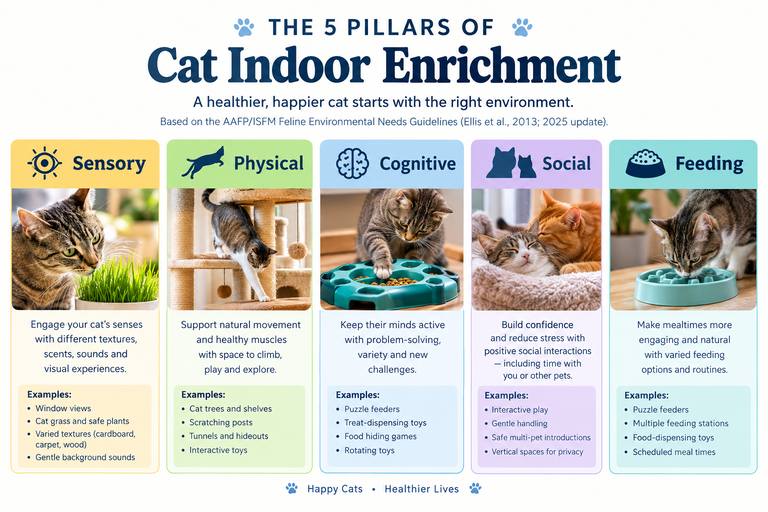
The AAFP and ISFM guidelines, first published in the Journal of Feline Medicine and Surgery in 2013 and reaffirmed in an updated position statement in 2025, organize a cat’s environmental needs into five pillars. Every enrichment idea in this guide maps back to one of them.
| Pillar | What it means | Quick example |
|---|---|---|
| 1. A safe place | A private, secure spot the cat can retreat to and control access to | An elevated box or covered perch with two exits |
| 2. Separated key resources | Food, water, litter, scratching, play, and resting areas that don’t overlap or compete | Litter box in a different room from the food bowl |
| 3. Play and predatory behavior | Real opportunities to stalk, chase, and “catch” something | A wand toy session that ends in a catch, not just chasing |
| 4. Predictable social interaction | Positive contact with people, on the cat’s terms, not forced | A consistent petting or play window at the same time daily |
| 5. Respect for the sense of smell | An environment that doesn’t overwhelm a cat’s primary threat-detection sense | Unscented litter; introducing new items gradually |
Failing to meet these needs doesn’t just make a cat “less happy” in the abstract. The guidelines’ authors and the veterinarians who’ve built on their work consistently link unmet environmental needs to specific, unwanted behaviors — not vague dissatisfaction.
Signs Your Cat Is Under-Stimulated — And Which Pillar Is Missing
This is the part most enrichment articles skip. A behavior problem is usually a clue, not a mystery, once you know which pillar it points back to.
| What you’re seeing | Likely missing pillar | Where to start |
|---|---|---|
| Scratching furniture instead of a post | Separated resources (Pillar 2) | See our guide on stopping furniture scratching |
| Avoiding the litter box, especially after a change at home | Separated resources / safe place | See litter box avoidance after a move |
| Restless at 2- 3 a.m., “zoomies” | Play and predatory behavior (Pillar 3) | Add a pre-bed hunt-and-catch play session |
| Hiding constantly, flinching at normal household noise | Safe place/sense of smell | See recognizing anxiety in cats |
| Overgrooming or excessive vocalizing | Multiple, often play + social | Start with Pillar 3, then Pillar 4 below |
A word of caution: these patterns are common associations, not a diagnosis. Sudden, severe, or worsening symptoms — especially straining in the litter box — need a veterinarian, not a wait-and-see enrichment plan. More on that at the end of this guide.
Pillar 1: Give Your Cat a Safe Place to Retreat To
A safe place isn’t a punishment corner — it’s a spot the cat chooses to control. The guidelines describe it as private, often raised, and ideally accessible from more than one side so the cat never feels trapped.
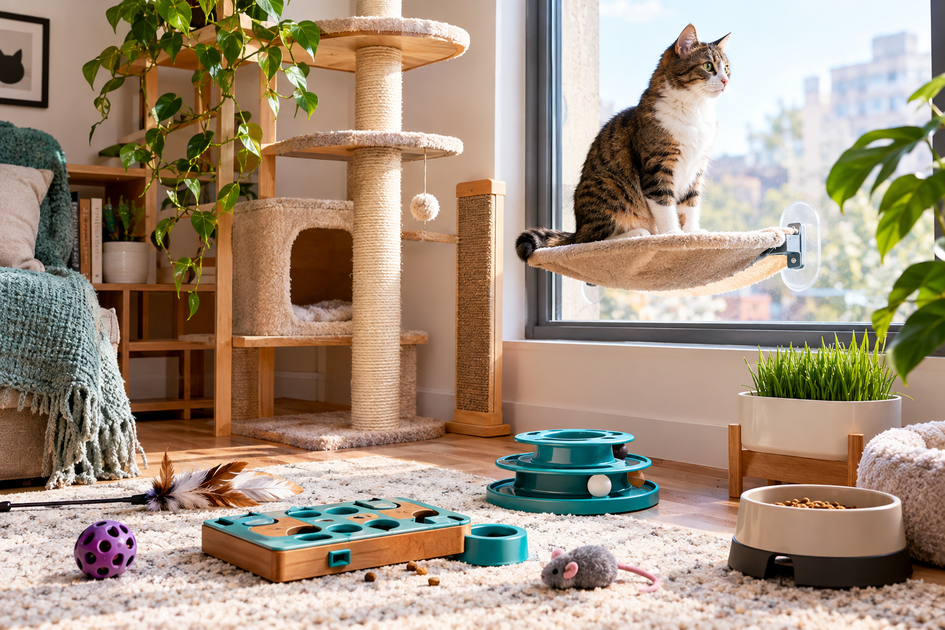
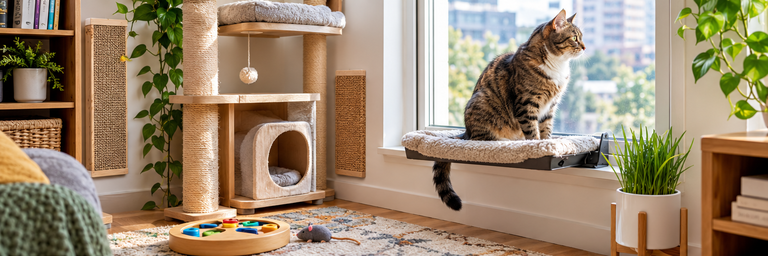
The simplest version costs nothing: a cardboard box on its side, tucked somewhere quiet. The upgraded version is a covered perch or wall shelf near a window, where the cat can watch the room without being in the middle of it.
Renter-friendly note: wall-mounted shelving needs a landlord’s sign-off in most leases, but freestanding cat trees, window-mounted perches that clip to the sill (no drilling), and tucked-away boxes all deliver the same “safe and elevated” combination without touching a wall.
Pillar 2: Separate the Key Resources
Food, water, litter, scratching, play, and resting areas each need their own space — not crammed into one corner of the kitchen. The guidelines specifically flag food-and-litter proximity as a common, easily fixed mistake: cats are naturally reluctant to eat near where they toilet.
For scratching specifically, location matters as much as the post itself — most cats want a scratcher near where they sleep or enter a room, not hidden away. If furniture scratching is already a problem in your house, our full guide to stopping it covers material, placement, and redirection in more detail, and if you’re choosing a new cat partly around this, some breeds are also just lower-drive scratchers than others.
If you’re also rethinking the litter setup itself, our Litter-Robot 4 review covers whether an automatic box is worth it for a multi-resource household.
Pillar 3: Feed the Hunting Instinct (Play and Puzzle Feeding)
This is the pillar most enrichment advice defaults to, and for good reason — it’s the one where the AAFP and ISFM guidelines are most direct: predatory behavior occurs even in well-fed cats, and failing to provide an outlet for it is linked to boredom and frustration that shows up as unwanted behavior.
Two things make play actually work as enrichment, not just exercise:
- The cat has to “catch” something, at least occasionally. A wand toy session that never ends in a capture can build frustration instead of relieving it.
- Feeding can double as play. A puzzle feeder or slow feeder turns a passive meal into a hunt, and rotating in high-value treats like Churu for a hidden-treat search adds a food-enrichment layer without extra calories from toys.
Two short sessions a day — ideally one before the hours cats are naturally most active, dawn and dusk — is a common starting point many veterinary behaviorists recommend, though every cat’s ideal amount varies with age and health.
Senior or arthritic cats still need this pillar, just adapted: lower-effort puzzle feeders, shorter sessions, and toys that don’t require jumping. If joint pain is a factor, our guide to arthritis in senior cats is worth reading alongside this section.
Pillar 4: Build Predictable, Positive Interaction
The key word in the guidelines is predictable, not more. Cats don’t necessarily want constant handling — they want interaction that happens on consistent terms they can anticipate and opt into.
That can be as simple as a set petting or brushing window at the same time each day, rather than intermittent attention whenever it’s convenient for you. Reading what your cat is actually communicating helps here too — behavior that looks aloof, like a cat’s unblinking stare, is often closer to trust than indifference once you know what to look for.
Never force interaction on a cat that’s retreating to its safe place (Pillar 1) — that undoes the sense of control the safe place is supposed to provide in the first place.
Pillar 5: Respect Your Cat’s Sense of Smell
Cats rely on scent for threat detection the way humans rely on sight, which is why the guidelines treat smell as its own pillar rather than a footnote. Strong, unfamiliar odors — including scented litter, plug-in air fresheners, and heavily fragranced cleaning products near key resources — can register as a low-grade, constant stressor.
The fix is mostly subtraction: unscented litter, introducing new furniture or products gradually rather than all at once, and keeping strongly-scented cleaning products away from food, water, and litter areas.
Putting It Together: A Simple Daily Enrichment Routine
You don’t need all five pillars fully built out before you see a difference. A workable starting routine:
- Morning: A 5-10 minute wand-toy session ending in a catch, then a puzzle-fed breakfast (Pillars 2 and 3)
- Midday: Rotate one toy, top off water in its separate spot (Pillar 2)
- Evening: A second short play session before your own bedtime, since this lines up with a cat’s natural activity window (Pillar 3)
- Ongoing: Keep the safe place accessible and undisturbed, and hold off on strong-scented products near key resources (Pillars 1 and 5)
Consistency matters more than volume. A predictable 15 minutes split across the day beats an hour of enrichment on Sunday and nothing the rest of the week.
When It’s More Than Boredom
Enrichment addresses under-stimulation — it isn’t a treatment for a diagnosed medical or clinical behavioral condition, and treating it as one can delay care your cat actually needs.
See a veterinarian rather than adjusting enrichment first if you notice:
- Straining in the litter box, or no urination at all — this can be a medical emergency, not a stress response
- Sudden onset of aggression, hiding, or appetite loss
- Overgrooming to the point of bald patches or skin irritation
- Any behavior change that’s sudden rather than gradual
Environmental stress is a recognized risk factor in some feline lower urinary tract conditions, which is part of why the guidelines matter — but a risk factor is not the same as a cause, and enrichment is not a substitute for a veterinary exam when symptoms are already present. If you’re seeing gradual behavior changes without acute symptoms, our guide to recognizing anxiety in cats is a useful next read.
If you also have a dog in the house, the same under-stimulation problem shows up differently — see our indoor dog enrichment guide for that side of a multi-pet household.
FAQ
How do I know if my indoor cat is bored?
Boredom in cats rarely looks restless in an obvious way. It’s more likely to show up as scratching outside a post, litter box avoidance, overgrooming, or nighttime activity spikes — check the diagnostic table above against what you’re actually seeing.
Do indoor cats really need this much enrichment?
Yes, more than outdoor cats do, not less. Outdoor cats get much of this from their environment automatically; indoor cats depend entirely on their owner to provide it, which is the core reasoning behind the AAFP/ISFM guidelines.
What’s the cheapest way to enrich an indoor cat?
A cardboard box for a safe place and a daily wand-toy session cover two of the five pillars for close to nothing. Puzzle feeders and vertical space are worth adding next, but they’re not where to start.
Can too much enrichment stress out a cat?
Introducing several new things at once can, mainly through Pillar 5 — cats generally do better with gradual change than a sudden overhaul. Add one or two elements at a time and watch how your cat responds.
Is enrichment enough to fix litter box or scratching problems?
Often it helps significantly, since both are frequently tied to Pillar 2. But if a litter box problem includes straining or no urination, see a vet first — that can be medical, not behavioral.
How much daily playtime does an indoor cat need?
Two short sessions a day, roughly 10-15 minutes each, is a common starting recommendation — though this varies by age, health, and individual cat. A kitten or young adult cat typically needs more than a senior cat with joint pain.
Conclusion
Five pillars sounds like a lot until you notice most homes are already meeting two or three of them without trying. Start with whichever one matches the behavior you’re actually seeing — the diagnostic table earlier in this guide is there for exactly that — rather than overhauling everything at once.
A cardboard box, a wand toy, and a five-minute session before bed cost nothing and cover more ground than most enrichment shopping lists suggest. Build from there, watch how your cat actually responds, and adjust instead of assuming one framework fits every cat identically.
If scratching, litter box avoidance, or anxious-looking behavior is what brought you here, separated resources (Pillar 2) are usually the ones doing the most work — worth starting there before anywhere else.
Sources: AAFP and ISFM Feline Environmental Needs Guidelines (Ellis et al., 2013, Journal of Feline Medicine and Surgery); AVMA News coverage of the 2025 updated FelineVMA position statement.