






Proper nutrition requires following established Pet Feeding Guidelines tailored to your animal’s specific age, weight, and daily activity level. Always measure portions accurately and consult your veterinarian to determine the precise dietary needs required for maintaining optimal health and longevity throughout their life.
Understanding these standards prevents obesity and nutrient deficiencies. This guide breaks down portion control, scheduling, and ingredient quality to ensure your companion thrives at every life stage.
Key Takeaways
- Feed by calories, not by scoops. Calculate your pet’s daily energy requirement (DER) from their resting energy requirement (RER), then check the kcal figure printed on the bag or can.
- Dogs and cats need different multipliers. A neutered adult dog runs around 1.6 × RER; a neutered adult cat is closer to 1.2 × RER.
- Body condition beats the scale. You should feel ribs easily under a thin fat layer and see a waist from above.
- Treats cap at 10% of daily calories, and they count toward the total.
- Set meals twice daily for most adults, and transition any new food over 7 to 10 days.
Decoding Basic Nutritional Requirements
Before diving into schedules and portions, it is crucial to understand what constitutes a balanced diet. Dogs and cats both belong to the order Carnivora, but their digestive biology took different paths, and their nutritional needs differ significantly as a result.
Dogs function as omnivores, capable of digesting a wide variety of foods, including vegetables and grains. Cats are obligate carnivores. Their bodies require nutrients found only in animal tissue, such as taurine, preformed vitamin A, and arachidonic acid, because they cannot manufacture them efficiently from plant sources. If you want the full side-by-side, our cat and dog food comparison breaks the differences down nutrient by nutrient.
A balanced diet generally consists of three macronutrients: proteins, fats, and carbohydrates. Protein is the building block for muscles, tissues, and enzymes.
High-quality animal protein should always be the first ingredient in your pet’s food. Fats provide energy and support healthy skin and coats.
They also carry the fat-soluble vitamins A, D, E, and K, so a diet too low in fat can quietly create vitamin gaps. Carbohydrates offer a source of quick energy and fiber, which aids in digestion.
Micronutrients, including vitamins and minerals, are equally important. Calcium and phosphorus support bone health, and they matter in ratio, not just in amount, which is why homemade diets go wrong so easily. Antioxidants like vitamin E and vitamin C support the immune system.
The Association of American Feed Control Officials (AAFCO) sets the standards for nutrient profiles in pet food. When shopping, look for the AAFCO nutritional adequacy statement on the label, which confirms the food meets minimum requirements for a specific life stage. You can learn more about these standards on the AAFCO website.
Read that statement closely. “Complete and balanced for maintenance” is not the same as “for growth and reproduction,” and “for intermittent or supplemental feeding only” means the product is a topper, not a meal. If you are comparing labels, our guide to essential nutrients for cats shows what a complete feline profile should include.
Ignoring these basic needs can lead to severe health consequences. A cat fed dog food long-term can develop taurine-deficient heart disease, which may be irreversible by the time symptoms appear.
Conversely, protein is not the enemy for healthy dogs, but pets with diagnosed kidney or liver disease often need protein and phosphorus managed by prescription. That is a veterinary decision, not a shelf decision. Understanding these distinctions is the first step in applying effective Pet Feeding Guidelines to your daily routine.

Life Stage Matters: Puppy, Adult, and Senior
One size does not fit all when it comes to nutrition. A growing puppy has vastly different energy requirements than a sedentary senior dog. Adjusting your feeding strategy as your pet ages is critical for preventing health issues later in life.
Puppies and Kittens
Young animals are in a rapid growth phase. They require more calories, protein, and specific minerals like calcium to support bone development. Large breed puppies, in particular, need controlled growth rates to prevent orthopedic problems such as hip dysplasia.
Feeding them a formula labeled for large-breed growth helps manage calcium and energy density, so they grow steadily rather than fast. Slower is safer for developing joints. Our puppy feeding tips guide covers the first year meal by meal.
Kittens need frequent meals, often three to four times a day, because their stomachs are small while their energy expenditure is high.
Adult Pets
Once your pet reaches adulthood, usually around one year of age, their growth stabilizes. The goal shifts from growth to maintenance. Overfeeding during this stage is a common pitfall.
Neutering also lowers energy needs while often increasing appetite, which is why so many pets gain weight in the months after surgery. Many adult pets become less active than they were as juveniles, but owners keep serving the same portions.
Adult maintenance formulas are calibrated to provide enough energy without excess calories. Recheck the portion any time your pet’s routine changes: a new work schedule, an injury, or a move to an apartment all shift the math.
Senior Pets
As pets enter their senior years, their metabolism slows, and activity often drops due to arthritis or other age-related conditions. Senior diets frequently feature fewer calories and added joint support such as glucosamine or omega-3 fatty acids.
The opposite problem is just as common. Some older pets absorb nutrients less efficiently and start losing muscle even while holding their weight. In those cases, a highly digestible diet with generous, high-quality protein is usually the better call.
Watch for the warning signs that a senior needs a diet review: dropping weight without a portion change, eating slowly or dropping food, or suddenly cleaning the bowl and asking for more. Any of those deserve an exam rather than a portion adjustment at home.
Regular veterinary check-ups are essential during this phase to adjust dietary plans as health needs change. The American Veterinary Medical Association (AVMA) recommends regular wellness exams to monitor these changes.
How to Calculate Portion Sizes
One of the most common questions owners ask is, “How much should I feed my pet?” The feeding charts on the back of food bags are a reasonable starting point, but they are generalized.
Those charts assume an average, moderately active animal and often assume an intact one. To get precise, you need to understand Resting Energy Requirements (RER) and Daily Energy Requirements (DER).
The RER Formula
The RER is the number of calories your pet needs to maintain basic bodily functions while at rest. The formula is:
RER = 70 × (Body Weight in kg)^0.75
For example, a 10 kg dog has an RER of approximately 393 calories.
Adjusting for Activity (DER)
Once you have the RER, multiply it by a factor based on lifestyle to get the DER. Dogs and cats use different multipliers, which is where a lot of home math goes wrong.
| Pet | Situation | Multiplier |
|---|---|---|
| Dog | Neutered adult | RER × 1.6 |
| Dog | Intact adult | RER × 1.8 |
| Dog | Weight loss | RER × 1.0 |
| Dog | Highly active or working | RER × 2.0 to 5.0 |
| Cat | Neutered adult | RER × 1.2 |
| Cat | Intact adult | RER × 1.4 |
| Cat | Weight loss | RER × 0.8 |
| Either | Growth (puppy or kitten) | RER × 2.0 to 3.0 |
Worked through, a 10 kg neutered adult dog lands at roughly 630 calories a day (393 × 1.6). A 4.5 kg neutered indoor cat comes in at around 260 calories (216 × 1.2). That gap between a small dog and a cat of similar size surprises most owners.
The math might look daunting, but online calculators handle it in seconds. The key point is that a neutered indoor dog needs fewer calories than an intact working dog of identical weight. Using these calculations means you are following science-based Pet Feeding Guidelines rather than guessing.
Turn Calories Into an Actual Portion
Calories only become useful once you convert them into food. Find the kcal/cup or kcal/kg figure on the bag, then divide your pet’s DER by it. Two foods that look identical in the bowl can differ substantially in calories per cup, so the printed number matters far more than the scoop.
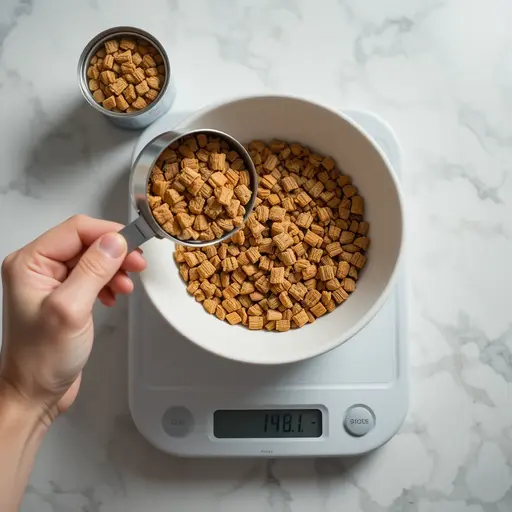
Weigh the food on a kitchen scale if you can. Veterinary researchers have repeatedly found that owners measuring kibble with a cup over- or under-serve by a wide margin, and a gram scale removes that error for a few dollars.
Treat every calculated number as a starting hypothesis, not a prescription. Weigh your pet every two to four weeks during any adjustment period. If they are gaining, trim the portion by about 10% and reassess in a month.
Read the Body, Not Just the Scale
Body condition scoring is more reliable than weight alone. Most veterinarians use a nine-point scale where 4 to 5 is ideal, and every point above ideal represents roughly 10% excess body weight.
Run three quick checks at home. You should feel the ribs easily with flat palms and light pressure, like the back of your hand. Looking down from above, there should be a visible waist behind the ribs. From the side, the belly should tuck up toward the hind legs rather than running parallel to the ground.
If your pet needs to lose weight, do it slowly and with veterinary input. Crash dieting a cat is genuinely dangerous, since rapid calorie restriction can trigger hepatic lipidosis. Our dog weight loss tips guide walks through a safe pace and how to keep a hungry dog satisfied.
Wet Food vs. Dry Food: Pros and Cons
The debate between wet and dry food is ongoing. Both have a place in a healthy diet, and the best choice depends on your pet’s health needs, their preferences, and your budget.
| Factor | Dry food (kibble) | Wet food (canned) |
|---|---|---|
| Moisture | Around 10% | Roughly 75 to 85% |
| Calorie density | High, so smaller volume | Lower, so larger volume |
| Cost per calorie | Lower | Higher |
| Storage | Shelf-stable, easy to portion | Refrigerate after opening, use within a few days |
| Palatability | Good for most pets | Usually higher, helpful for picky or sore-mouthed pets |
| Best suited to | Puzzle feeders, budget feeding, easy measuring | Cats prone to urinary issues, seniors, weight loss on volume |
Dry Food (Kibble)
Dry food is the most popular option for convenience. It is cost-effective, easy to store, simple to measure, and works in puzzle feeders and slow bowls.
Kibble is sometimes credited with cleaning teeth, but standard kibble shatters rather than scrapes and does little for the gumline. Only foods specifically formulated and tested for dental benefit make a real difference, and none of them replace brushing.
Because it is energy-dense, you feed a smaller volume than with wet food. The tradeoff is moisture: dry food typically contains only about 10% water.
For cats, who evolved to get most of their water from prey and have a low thirst drive, an all-dry diet can mean chronically low water intake. That matters most for cats with a history of urinary crystals, blockages, or kidney disease.
Wet Food (Canned)
Wet food contains significantly more moisture, often 75 to 85%. That helps keep pets hydrated, which is particularly useful for cats prone to kidney or urinary problems. Our guide to diets for cats with kidney disease covers where moisture fits into a broader management plan.
Wet food also tends to be more palatable, making it a strong choice for picky eaters, pets recovering from illness, and seniors with dental pain. The extra volume per calorie can help a dieting pet feel fuller too.
The downsides are cost and handling. Once opened, cans need refrigeration and should be used within a couple of days, and food left in the bowl spoils quickly at room temperature.
The Hybrid Approach
Many veterinarians recommend a combination. Dry food during the day handles convenience and puzzle feeding, while a wet meal at dinner adds moisture and enrichment.
Just count both toward the same daily calorie budget rather than treating the wet portion as a freebie. That single habit prevents most of the accidental weight gain that comes with adding a topper.
Establishing a Feeding Schedule
Consistency is key when implementing Pet Feeding Guidelines. Pets thrive on routine, and a predictable schedule supports digestion, house training, and your ability to notice when something is off.
| Life stage | Meals per day |
|---|---|
| Puppies under 4 months | 3 to 4 |
| Puppies 4 to 6 months | 3 |
| Puppies 6 to 12 months | 2 |
| Adult dogs | 2 |
| Kittens under 6 months | 3 to 4 |
| Kittens 6 to 12 months | 2 to 3 |
| Adult cats | 2 to 3 small portioned meals |
| Seniors | 2, adjusted for appetite and dental comfort |
Meal Feeding vs. Free Feeding
Meal feeding means specific portions at set times, usually twice a day for adults. Most veterinarians recommend it.
It lets you monitor appetite closely. If your pet skips a meal, you know the same day rather than a week later, and appetite loss is often the earliest sign of illness in cats. Set meals also prevent food competition in multi-pet homes and let you feed different diets to different animals.
Free feeding, or leaving food out all day, is common but tends to produce overeating and makes intake impossible to track.
If your pet is prone to obesity, skip free feeding entirely. It still has a place for nursing mothers, underweight animals, and some medical recoveries, but those are short-term situations with a vet’s guidance.
Timing Matters
Feed at roughly the same times each day. For dogs, feeding after a walk helps establish a predictable bathroom routine.
Avoid vigorous exercise right around a large meal, especially with large and giant breeds, because of the risk of bloat and gastric dilatation-volvulus. GDV is a surgical emergency, and the classic signs are a distended abdomen, unproductive retching, restlessness, and drooling. That is an immediate emergency-vet call, not a wait-and-see.
Cats naturally prefer many small meals. Timed feeders and food puzzles let you honor that pattern while still controlling total calories, and they slow down fast eaters who vomit after gulping.
Water Deserves the Same Attention
Fresh water should always be available, in more than one spot. A rough rule of thumb is about an ounce of water per pound of body weight per day, though it shifts with diet, weather, and activity.
Cats are often fussy about water sources. Wide bowls that keep whiskers off the sides, locations away from the food and litter box, and running fountains all measurably increase how much some cats drink.
A sudden jump in thirst is worth a vet visit. Increased drinking and urination can signal diabetes, kidney disease, or hyperthyroidism, and catching those early changes improves outcomes.
Common Feeding Mistakes to Avoid
Even careful owners make mistakes that affect their pet’s health. Knowing the usual traps helps you stay on track.
- Ignoring treat calories: Treats should stay under 10% of daily calories. A few biscuits, a dental chew, and a lick of peanut butter add up faster than most owners expect, and for a small dog they can easily overshoot the whole budget.
- Feeding human food carelessly: Some human foods are fine, but several are dangerous. Onions, garlic, chocolate, grapes and raisins, macadamia nuts, and xylitol are all toxic. Even safe extras can unbalance a complete diet if they replace real meals. Our list of safe vegetables for pets covers what actually works as a low-calorie treat.
- Switching food too quickly: Abrupt diet changes commonly cause vomiting or diarrhea. Transition over 7 to 10 days by gradually increasing the new food’s share, and follow a structured plan like our guide to transitioning pet food safely.
- Assuming “natural” means better: Terms like natural, holistic, premium, and human-grade carry little regulatory weight. The nutritional adequacy statement and the manufacturer’s willingness to answer questions about formulation and testing tell you far more than the front of the bag.
- Measuring by eye: Scooping “about a cup” is one of the most common causes of slow weight gain. A gram scale, or at minimum a level measuring cup used the same way every time, fixes it.
- Forgetting who else is feeding the pet: In a household of several people, double feeding is routine. A whiteboard or a checked-off feeding chart solves a problem no diet change can.
- Neglecting water and dental health: Dehydration develops quickly in hot weather or on an all-dry diet, and painful teeth change how a pet eats long before you notice weight loss.
For a list of toxic foods, refer to the resources provided by VCA Animal Hospitals.
FAQs
How often should I change my pet’s food?
There is no medical need to rotate proteins frequently if your pet is healthy and thriving on their current diet. Some owners rotate to prevent boredom or reduce the impact of supply problems and recalls. If you do switch, do it gradually over 7 to 10 days.
Are grain-free diets better for pets?
Not for most pets. True grain allergies are uncommon, and grains supply useful nutrients and fiber. The FDA has investigated a possible association between certain grain-free and legume-heavy diets and canine dilated cardiomyopathy without establishing a causal link, and the science remains unsettled. Our science-based review of grain-free dog food lays out what is and is not known. Talk to your veterinarian before choosing a grain-free diet.
My pet is a picky eater. What should I do?
First, rule out medical causes, especially dental pain and nausea. If your pet is healthy, stay consistent: offer the meal for 20 minutes, then remove it until the next scheduled feeding. Avoid substituting treats or table food, which teaches your pet that refusing dinner produces something better. One important exception is cats, who should not go without eating for more than about 24 hours. Call your vet if a cat refuses food that long.
Can I feed my dog cat food?
An occasional stolen bite is not a crisis, but it should not become a routine. Cat food is considerably higher in protein and fat, which can lead to weight gain and, in susceptible dogs, pancreatitis.
How much water should my pet drink each day?
A common rule of thumb is roughly one ounce per pound of body weight daily, with pets on wet food drinking noticeably less from the bowl. What matters more than the exact number is a sudden change. A marked increase or decrease in drinking warrants a veterinary exam.
Is one meal a day enough for an adult dog?
Two meals a day suits most adult dogs better, spreading calories out and reducing the long stretch on an empty stomach. Research on feeding frequency is still developing, and some healthy adult dogs do fine on one meal, so treat it as a conversation with your vet rather than a settled rule. Puppies, cats, and dogs with any history of vomiting or blood-sugar issues should not be fed once daily.
How do I know if my pet is overweight?
Use the hands-on checks rather than the scale. Ribs should be easy to feel with light pressure, a waist should be visible from above, and the belly should tuck upward when viewed from the side. If any of those are missing, ask your vet for a body condition score at the next visit and a target weight to work toward.
How long should it take my pet to lose weight?
Slowly. Safe weight loss is generally around 1 to 2% of body weight per week for dogs and slower for cats, which means real progress takes months. Faster loss risks muscle wasting, and in cats, aggressive restriction can trigger serious liver problems. Any weight-loss plan should be built with your veterinarian.
Conclusion
Feeding your pet well comes down to three habits: know the calorie target, measure what you actually serve, and check your pet’s body condition every few weeks. Everything else in pet nutrition is refinement on top of those.
Pet Feeding Guidelines are not static. They should shift when your pet is neutered, when activity drops, when a senior starts losing muscle, and whenever a new diagnosis changes the picture.
Your veterinarian remains the most valuable tool you have. They can score body condition objectively, set a realistic target weight, and adapt the plan for medical conditions that override any general advice.
Whether you feed wet, dry, or both, consistency and observation matter more than brand loyalty. Watch energy, coat quality, stool, and weight over time.
Those are the honest indicators of whether a diet is working. Start this week: weigh the food instead of scooping it, and write down what your pet actually weighs so you have a baseline to measure against.