




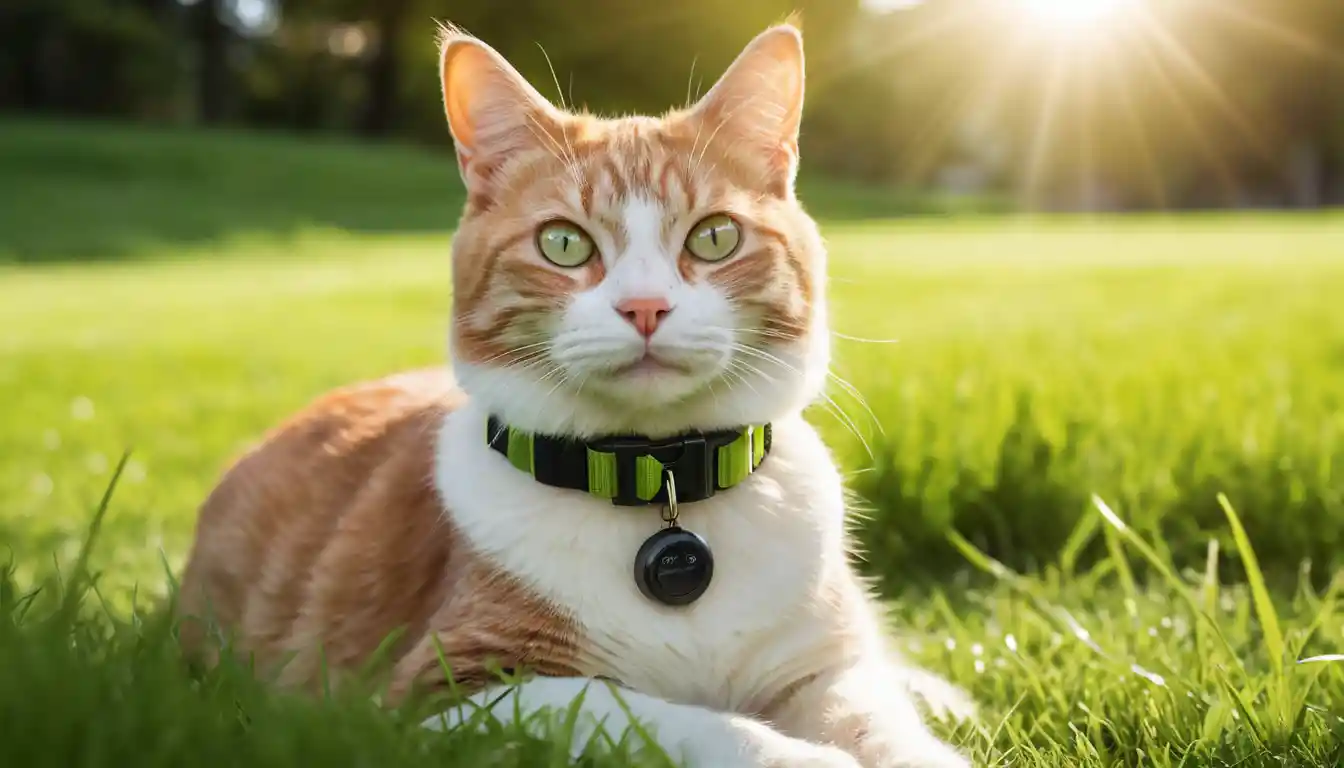
A cat tracker is a small device attached to your pet’s collar that uses GPS, radio frequency, or Bluetooth to show your cat’s location. It helps you find a missing cat faster and reduces the panic of not knowing where they are. Modern trackers pack real safety features into a lightweight design that cats barely notice once they’re used to it.
This guide explains how cat trackers actually work, which features matter most, and which specific models are worth buying, including a couple of once-popular options we’re no longer recommending, and why.
Key Takeaways
- GPS/cellular trackers are best for cats who roam widely; they require a subscription and typically cost $5–$13/month, depending on the plan length.
- RF trackers are subscription-free and great for neighborhood roamers, but you have to actively search with a handheld receiver; there’s no live map.
- Bluetooth trackers like Apple AirTag work well for indoor cats and hiding spots, but aren’t reliable for cats that leave the property.
- Weight matters most. A tracker that’s too heavy for your cat’s size is the single biggest safety risk, more than any feature comparison.
- We removed one previously recommended tracker, Pawtrack, after finding widespread, credible reports that the company doesn’t ship working units or honor cancellations. Don’t buy it.
Why Cat Trackers Beat Traditional Methods
Microchips are essential for permanent ID, but they only work after someone finds your cat and takes them to a shelter or vet to be scanned. A cat tracker closes that gap by giving you real-time location data the moment your cat goes missing.
Estimates vary by study, but the most-cited figure from a 2012 ASPCA-funded survey of over 1,000 households found that about 15% of cats go missing at least once over five years, and outdoor-access cats face the highest risk.
Later research adds nuance: most lost cats that are recovered are found close to home, often within a few hundred meters of where they escaped, and the first week matters most for a live recovery.
Here’s why proactive tracking is worth it:
- Speed matters. Most cats that are found alive are located within the first week. A tracker skips the “wait and hope” phase entirely.
- Prevents escalation. A geofence alert lets you intervene before your cat gets near a road or other hazard.
- Reduces stress. Knowing where your cat is, or at least where they were last seen, takes the edge off the panic.
- Complements microchips. The tracker gets them found now; the microchip is the backup if the collar comes off.
A bell or breakaway collar alone tells you nothing about where your cat is once they’re gone. A dedicated tracker changes that.
How Cat Trackers Actually Work
Different tracking technologies offer very different accuracy, range, and cost tradeoffs.
GPS + Cellular Trackers: Precision for Wide-Ranging Cats
These combine satellite GPS for location with a cellular connection (a built-in SIM card, like your phone) to send that data to an app.
- Best for: Cats who roam beyond your yard, explore the neighborhood, or live in suburban/rural areas with cell coverage.
- Requires a subscription. Every real-time GPS/cellular tracker needs an ongoing data plan; there’s no way around this, since the SIM card has to stay connected. Expect roughly $5–$13/month, depending on how many years you prepay.
- Battery life: Typically 2–7 days, depending on how often it updates and whether “live” mode is active.
- Accuracy: Generally good (10–50 ft outdoors) but degrades in dense urban areas, thick tree cover, or indoors.
Radio Frequency (RF) Trackers: Simple, Affordable & Subscription-Free
These work like a “find my keys” device, using a handheld receiver instead of cellular data.
- Best for: Cats who stay relatively close to home, or owners who want to avoid subscriptions entirely.
- No subscription, one-time purchase only.
- Limited, line-of-sight range, usually a few hundred feet to a couple of miles, depending on the model and obstacles.
- Manual search: No live map. You walk toward the signal using the handset’s direction and strength indicators.
- Battery life: Often 6+ months thanks to low power draw.
Bluetooth Trackers: Ultra-Short-Range Convenience
Popularized by Tile and Apple AirTag, these rely on Bluetooth Low Energy and, in Apple’s case, a crowd-sourced device network.
- Best for: Primarily indoor cats who hide, or very cautious cats that rarely leave the yard. Not a substitute for real outdoor tracking.
- Very short range (roughly 100–300+ ft) unless another compatible device happens to be nearby to relay the signal.
- Minimal battery draw, often lasting close to a year.
- Low cost, usually no subscription.
Choosing the right tech: if your cat regularly explores beyond your street, go GPS/cellular. For a cat that mostly stays in the neighborhood, RF gives solid value without ongoing fees. Bluetooth is best as a supplement or for strictly indoor cats.
7 Must-Have Features in a Safe & Effective Cat Tracker
Not all cat trackers are created equal; prioritizing feline safety and real usability matters more than a long feature list.
- Ultra-lightweight design (under 30g). A heavy tracker strains your cat’s neck and increases the odds they’ll wriggle out of the collar. Veterinarians commonly advise keeping any collar attachment under roughly 5% of your cat’s body weight. For a typical 10 lb cat, that’s a ceiling around 225g, but you should aim well under that. Under 30g is a reasonable, practical target for comfort. Always check the manufacturer’s exact weight, including the collar attachment, not just the tracker unit.
- Secure, breakaway collar integration. The tracker must attach to a proper breakaway collar that releases under pressure, never a standard buckle collar, which can become a choking hazard if snagged.
- Long battery life and practical charging. GPS trackers: aim for a minimum of 3–5 days per charge. RF trackers: 6+ months is standard. Magnetic charging is safest since it avoids exposed ports near fur and water.
- Real-time tracking and geofencing. You want live location updates on a map, plus customizable geofences that alert you the moment your cat leaves a defined safe zone.
- Reliable accuracy and coverage. Look for models using multiple satellite systems (GPS, GLONASS, Galileo) and check that cellular coverage maps actually include your area before buying.
- Durable, weather-resistant build. Look for an IP67 rating or higher (dust-proof and water-resistant). Cats explore rain, mud, and snow.
- A genuinely usable app. It should show location clearly, let you set geofences in a few taps, send reliable push notifications, and let you quickly share your cat’s location with family if needed.
Skip trackers that: exceed roughly 35g, lack breakaway collar compatibility, have a pattern of app or connectivity complaints in recent reviews, or come from a company with unresolved billing or shipping complaints. More on that below.

Best Cat Trackers Reviewed
A note before the picks: cat tracker brands change fast, and the category has seen real churn recently. Whistle GO Explore was discontinued in 2025 after Tractive acquired the brand, and a couple of other older names quietly stopped selling.
Cat-specific gear from smaller brands is also where we found the most unverifiable marketing claims, so treat any tracker not covered here with extra scrutiny before buying, especially around subscription cancellation terms.
Budget Champion: Tabcat V2 RF Tracker
- Best for: Cost-conscious owners, cats with limited roam, no interest in subscriptions.
- Key specs: Tag weight around 5g | Range up to roughly 400 ft line-of-sight | No monthly fee, one-time purchase | Waterproof tag
- Why we like it: A genuinely subscription-free RF locator from Loc8tor, a company that’s been making these since the mid-2000s. The handheld receiver uses lights and beeps to guide you toward your cat, no app, no map, no ongoing cost. Downside: short range and no live tracking; you have to actively search rather than glance at your phone.
We previously recommended Pawtrack in this slot. We’re removing that recommendation: Pawtrack is a cellular GPS product (not RF, despite how it’s often marketed), and there is a substantial, recent pattern of customer reports, including on Trustpilot, describing units that never arrive or don’t work, subscription charges continuing after cancellation, and an unresponsive support team. We can’t verify the company is currently able to fulfill orders reliably, so we don’t recommend it.
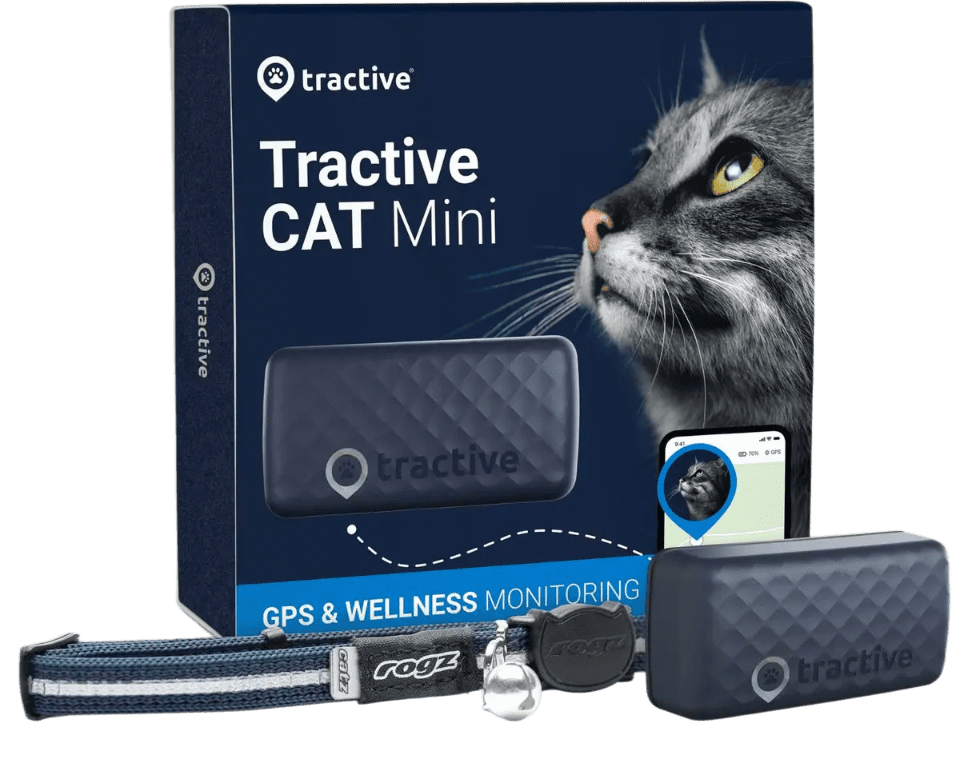
Premium GPS Pick: Tractive GPS Cat Tracker
- Best for: Outdoor cats, real-time nationwide tracking, and activity/wellness monitoring.
- Key specs: Around 1 oz (roughly 28–32g) including the collar attachment | Battery up to about 5 days | IP68 waterproof | Live tracking, geofencing, activity, and sleep monitoring
- Why we like it: Consistently rated as the most accurate real-time tracker in independent testing, with minimal lag in live mode. Health tracking (activity, sleep, and newer models resting heart rate) is a genuine bonus, not just a marketing bullet.
- What changed: Tractive’s pricing has shifted. Subscriptions now run roughly $5/month if you prepay a 5-year plan, up to around $9–$13/month on shorter terms. Check current plans before buying, since month-to-month availability varies by region, and Tractive was acquired by Bending Spoons in 2025.
Lightweight Champion: Fi Mini GPS Tracker
- Best for: Small cats or any cat sensitive to collar weight.
- Key specs: 16g | Clips onto your cat’s existing collar (fits 3/8″–1″ wide) | Battery lasts around 3 weeks | LTE-M cellular (Verizon network at launch)
- Why we like it: Released in 2025, this is one of the few trackers genuinely light enough for small cats without needing a dedicated collar; it clips onto whatever breakaway collar your cat already wears. Downside: shorter battery life than bulkier GPS units, and it’s subscription-based (roughly $8–$12/month depending on term).
Best for Indoor Cats: Apple AirTag (with a Dedicated Cat Collar Loop)
- Best for: Primarily indoor cats who hide, leveraging Apple’s Find My network.
- Key specs: About 1 oz for the tag alone, plus a breakaway loop | Bluetooth range (~300+ ft) plus crowd network | Battery roughly a year, replaceable
- Why we like it: Apple released an updated AirTag in January 2026 with a longer-range chip and a louder speaker, still priced at $29 single / $99 for four. If your indoor cat gets out and a nearby iPhone user’s device is within range, it can help locate them via the passive Find My network. Crucially: use a dedicated breakaway AirTag loop made for cats, never tape, glue, or use a standard keyring attachment.
- Warning: Don’t rely on an AirTag alone for an outdoor cat. The crowd network is passive and can lag badly in low-device-density areas, and there’s no live tracking.
Honorable Mention: Marco Polo Advanced Pet Tracker
An RF-style tracker (technically a radar-based system) from Eureka Technology with a genuinely long range for a subscription-free device useful for rural or off-grid properties where cellular coverage is patchy. It costs more upfront than Tabcat but covers considerably more ground.
Quick Comparison
| Feature | Tabcat V2 | Tractive GPS | Fi Mini | Apple AirTag |
|---|---|---|---|---|
| Weight | ~5g (tag) | ~28–32g | 16g | ~11g + loop |
| Tracking type | Radio frequency | GPS/Cellular | GPS/Cellular (LTE-M) | Bluetooth + crowd network |
| Range | ~400 ft | Nationwide (cellular coverage dependent) | Nationwide (cellular coverage dependent) | ~300+ ft, or wherever an Apple device is nearby |
| Subscription | None | Required, ~$5–$13/mo | Required, ~$8–$12/mo | None |
| Best for | Budget, local roamers | Active outdoor cats | Small/weight-sensitive cats | Indoor-only cats |
Using Your Cat Tracker Safely
A cat tracker is only as good as how it’s used. A few non-negotiables:
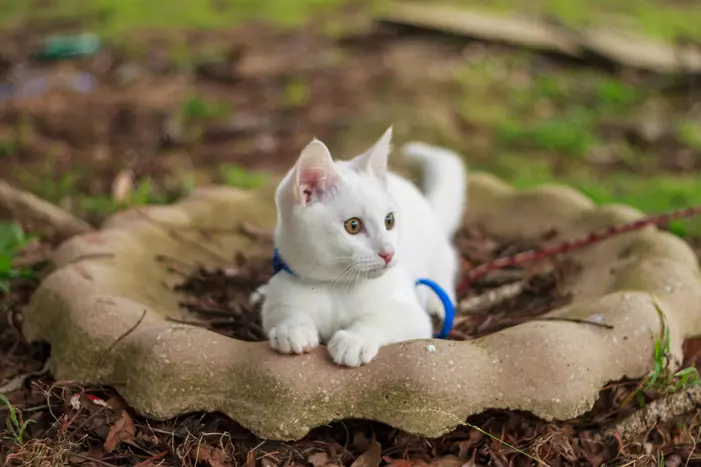
Proper collar fit matters most. Always use a breakaway collar made for cats; a standard dog collar or a non-breakaway cat collar is a real choking hazard if snagged on something. Use the two-finger test: you should be able to fit two fingers snugly between the collar and your cat’s neck. Check the collar and attachment point daily for wear or irritation, and adjust as your cat’s weight changes.
Respect the weight limit. The tracker-plus-collar combo should stay well under 5% of your cat’s body weight. If in doubt, choose the lighter option. A tracker that’s uncomfortable enough to cause scratching, head-shaking, or hiding needs to come off and be reassessed, and your veterinarian can advise on what’s appropriate for your specific cat.
Introduce it gradually. Let your cat sniff the tracker first. Attach it loosely for short 15–30 minute sessions with treats and play, then build up wear time over several days.
Understand the technology’s limits. GPS struggles indoors, in dense forests, and in urban canyons. A “stuck” location usually means a blocked signal, not a motionless cat. Batteries aren’t infinite; check the app daily and set low-battery alerts. Geofence alerts tell you your cat has already left the zone, but they don’t stop them from leaving. No tracker is foolproof: collars can break, devices can fail. Keep other safety measures in place, too, like secure window screens and supervised outdoor time.
Mind your data. Choose a brand with a clear privacy policy, use a strong, unique password for the app account, and disable location sharing when you don’t need it.
Used correctly, a cat tracker becomes a genuine safety net rather than just a gadget.
FAQs
Can a cat tracker hurt my cat?
Not if it’s chosen and used correctly. The real risks come from trackers that are too heavy (neck strain) or attached to a non-breakaway collar (choking hazard). Prioritize lightweight models on a proper breakaway collar and introduce them gradually.
Do cat trackers work inside my house?
GPS trackers often struggle indoors due to signal blockage. RF trackers work best in line-of-sight and are hindered by walls. Bluetooth trackers like AirTag have a short indoor range. All three technologies are primarily designed for outdoor use; indoor performance has real limitations.
Are there cat trackers without monthly fees?
Yes. RF trackers like Tabcat V2 and Marco Polo are one-time purchases with no subscription. Bluetooth trackers like Apple AirTag also have no ongoing fee. Any GPS/cellular tracker offering real nationwide, real-time coverage requires a monthly or annual data plan. There’s no way around this, since it needs an active cellular connection to send location data.
How accurate are cat trackers really?
It varies by technology. GPS trackers are generally accurate within 10–50 feet in open areas, but can be off by 100+ feet near tall buildings or dense trees. RF trackers get more precise as you physically get closer to the signal. Don’t expect phone-level pinpoint accuracy; focus on the general area and direction.
What’s the best tracker for a very small cat or kitten?
Weight is the deciding factor. The Fi Mini (16g) and Apple AirTag with a dedicated loop (~11g plus loop) are the lightest options here. Make sure the entire setup collar plus tracker stays well under 5% of your kitten’s body weight, use a properly sized breakaway collar, and watch closely for any signs of discomfort.
Conclusion
Choosing the right cat tracker turns the terrifying unknown of a missing cat into actionable information. Prioritize a lightweight design, secure breakaway collar integration, and tracking technology suited to how your cat actually roams: GPS/cellular for wide-ranging explorers, RF for neighborhood adventurers, or Bluetooth strictly for indoor hiders.
No tracker replaces vigilant supervision and a secure environment, but the right one meaningfully boosts your odds of a fast, safe return. Before you rely on it, test your tracker’s range and app in your own neighborhood during daylight, and before you buy any tracker not covered here, spend five minutes checking recent reviews for subscription or shipping complaints. That’s exactly the kind of check that would have flagged the issues we found with Pawtrack.