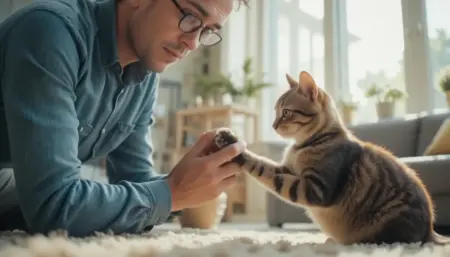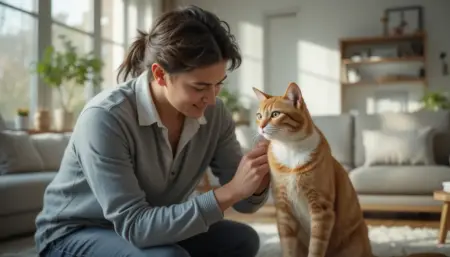






Petting a cat isn’t just a feel-good activity; it’s a two-way conversation that reveals a wealth of behavioral clues. By learning where, how, and when to touch, you can read your cat’s body language, reduce its stress, and deepen trust in just a few minutes a day.
Below you’ll discover the science, signals, and step-by-step tactics that turn casual strokes into purposeful bonding.
Key Takeaways
- Cats give real-time feedback during petting: slow blinks, kneading, and head-butts mean “keep going,” while tail lashing, flattened ears, or a stiffened body mean “stop.”
- The safest zones are the cheeks, chin, and the area between the eyes and ears; the tail base, belly, and paws are the most likely to trigger a swat.
- A short, structured routine of days of quiet observation followed by brief, rewarded touches builds trust faster than long or forced sessions.
- Sudden changes around petting, like new aggression, hiding, or a jump in vocalization, can be an early sign of pain or illness worth a vet visit.
Understanding Cat Behavior Basics
Cats communicate mainly through posture, tail movement, ear position, and vocalizations. Reading these signals correctly tells you when a petting session is welcome and when it’s time to pause.
Body Language Overview
| Signal | Typical Meaning | How to Respond |
|---|---|---|
| Slow blink | Trust and affection | Return the blink as a silent “I love you.” |
| Tail upright with a tip curl | Friendly greeting | Offer gentle petting; the cat is open. |
| Ears forward | Alert, curious | Approach slowly, let the cat lead. |
| Puffed tail | Fear or aggression | Give space; avoid petting until calm. |
| Mid-air swat | Overstimulation | Stop touching immediately, redirect focus. |
Vocal Cues
- Purr: Often content, but can also mask pain; check the context.
- Chirrup/trill: Excitement and an invitation to interact.
- Hiss or growl: A clear sign of discomfort; stop petting.
Why Body Language Matters
- Predicts reactions: Reading the signals early helps you prevent bites or scratches.
- Builds trust: Responding appropriately reinforces positive associations with your touch.
- Protects health: Cats under chronic stress are more prone to flare-ups like stress cystitis or herpesvirus outbreaks, so calmer interactions support their overall health.
Understanding these basics creates the foundation for purposeful petting and everything else in this guide.

How Petting Influences Cat Behavior
Touch changes a cat’s physiology in real time; it’s linked to a rise in bonding hormones and a drop in stress hormones, but only when the cat welcomes the contact.
The Science Behind the Stroke
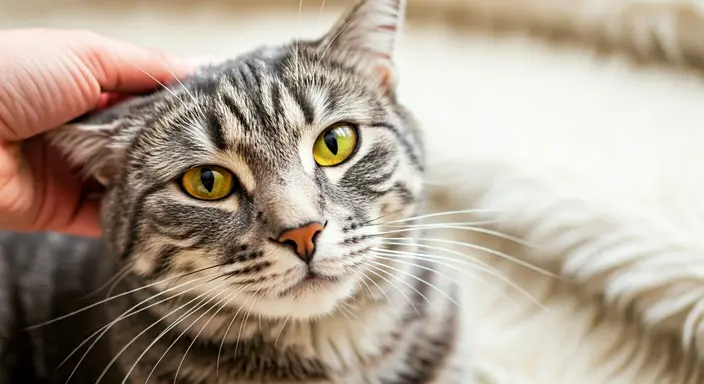
- Cheek, chin, and temporal glands (the area between the eyes and ears) mark you as safe. Research comparing stroking locations found cats respond most positively when touched in this temporal region, growing more guarded near the tail base, echoing how cats greet each other by rubbing faces together, not tails.
- Gentle, cat-initiated touch has been linked in owner studies to a rise in oxytocin, sometimes called the bonding hormone, in both the cat and the person, alongside a drop in cortisol, the primary stress hormone.
- That shift reflects the parasympathetic “rest and digest” state, the same system behind a slower heart rate and a looser, more relaxed posture.
Safe vs. Sensitive Zones
| Safe Zone (Gentle petting) | Sensitive Zone (Avoid) |
|---|---|
| Between the eyes and ears (cheek/temporal glands) | Base of tail |
| Chin and jawline | Belly (unless the cat invites it) |
| Back, between the shoulder blades | Lower back, near the hindquarters |
| Top of the head (light touch) | Paws and legs |
How to Use Petting to Shape Desired Cat Behavior
- Reinforce calmness: After a short stroke, reward with a treat if the cat stays relaxed.
- Redirect overstimulation: Watch for tail flicks and pause petting before your cat reaches its “too much” threshold.
- Encourage socialization: Pair gentle touch with a soft, consistent voice tone; more cautious cats may just need extra repetition before they associate your presence with safety.
Leveraging these physiological effects can guide your cat toward greater sociability and reduced anxiety over time.
Reading Cat Behavior While Petting
Even relaxed cats send frequent, subtle cues during a petting session; telling positive, neutral, and negative signals apart in the moment prevents most bites and scratches.
Positive Signals
- Slow, rhythmic purring – Keep petting; the cat is content.
- Kneading paws – Often a sign of comfort; consider a soft blanket beneath the cat.
- Head-butt (bunting) – The cat is marking you with scent; give a gentle scratch behind the ears.
Neutral Signals
- Tail twitching side-to-side – Indicates mild arousal; reduce pressure or change location.
- Ear flicks – The cat is processing sounds; keep ambient noise low.
Negative Signals
| Cue | Interpretation | Immediate Action |
|---|---|---|
| Rapid tail lashing | Irritation or overstimulation | Stop petting, give space |
| Pupil dilation | Fear or alertness, especially with flattened ears | Calm voice, retreat a few inches |
| Growl or low hiss | Clear warning | Cease contact, let the cat retreat |
Learning to pause at the first hint of discomfort prevents escalation and teaches your cat that you respect its boundaries, essential for a trusting relationship.
Signs of Discomfort in Cat Behavior
Every cat has a personal tolerance threshold for touch. Overstimulation typically escalates through predictable stages from a tail flick to a sheathed-claw swat to a full bite, so catching it early keeps things from getting there.
The “Overstimulation” Spectrum
- Early stage – Tail tip flick. A light warning; pause briefly.
- Mid stage – Swatting with claws sheathed. Stronger displeasure; stop petting and redirect.
- Late stage – Full-blown bite or aggressive swat. The cat’s limit is reached; give it space for several minutes.
Additional Red Flags
- Flattened ears against the head – The cat feels threatened.
- Whipping of the whole tail – Indicates high arousal; back off.
- Rising hackles on the back – A sign of fear; stop all contact.
How to De-Escalate
- Give the cat a “time-out” area (a quiet room or cat tree).
- Speak softly and avoid direct eye contact, which can seem confrontational.
- Offer a treat after a brief break to rebuild the association between you and calm.
Understanding these negative cues preserves the trust you’ve built and helps prevent fearful or aggressive patterns from taking hold.
Building Trust with Purposeful Petting to Shape Cat Behavior
Trust isn’t granted instantly; it’s earned through predictable, respectful touch. Below is a step-by-step program you can follow over a few weeks to turn casual strokes into a strong, trusting bond.
Phase 1 – Observation (Days 1-3)
- Sit quietly near the cat’s favorite spot.
- Watch for natural approaches (e.g., rubbing against your legs).
- Log body language in a notebook: tail position, ear orientation, vocalizations.
Phase 2 – Initiated Short Touches (Days 4-7)
- Approach from the side, not head-on.
- Offer a fingertip to the cat’s nose; if it sniffs, proceed.
- Pet for 3-5 seconds in a safe zone (chin or behind the ears).
- Reward with a treat immediately after the cat stays calm.
Phase 3 – Gradual Extension (Weeks 2-3)
- Increase petting duration by 5-second increments each session.
- Introduce new locations (back between the shoulder blades, top of the head).
- Continue treat reinforcement for relaxed posture and slow blinking.
Phase 4 – Maintenance (Beyond Week 3)
- Keep sessions under 2 minutes unless the cat actively seeks more.
- Alternate petting with play; a feather wand or laser pointer keeps the interaction enjoyable.
- Conduct a weekly “trust check”: note any new sensitivities and adjust accordingly.
Following this structured approach reshapes your cat’s response to handling over time, while making sure it never feels forced.
Enriching the Environment for Positive Cat Behavior
A cat whose environment already meets its need for climbing, scratching, hunting-style play, and mental stimulation is far more likely to stay relaxed during petting sessions.
Essential Enrichment Items
| Category | Example | Benefit |
|---|---|---|
| Vertical Space | Cat tree, wall-mounted shelves | Allows safe observation points; reduces territorial stress. |
| Interactive Toys | Feather wands, motorized mice | Channels predatory instincts, burns excess energy. |
| Scratching Posts | Sisal, carpet, corrugated cardboard | Protects furniture; marks territory healthily. |
| Puzzle Feeders | Treat-dispensing balls | Provides mental stimulation, slows eating. |
| Scent Enrichment | Catnip, silvervine, herbal sprays | Encourages play, reduces anxiety. |
Rotation Schedule
- Weekly: Swap toys or rotate the locations of scratching posts.
- Monthly: Introduce a new scent or replace a worn-out toy.
Changing the environment keeps things from going stale, encourages exploration, and makes petting sessions feel like a reward rather than a routine chore.
Health Insights Hidden in Cat Behavior
Cats mask illness well, so subtle shifts you notice during petting and daily handling changes in coat quality, vocalization, or touch tolerance are often the first clue something is wrong.
Key Behavioral Health Indicators
| Behavior Change | Possible Health Issue | Action |
|---|---|---|
| Decreased grooming (matting, greasy coat) | Dental disease, pain, arthritis | Schedule a dental exam; check joints. |
| Increased vocalization at night | Hyperthyroidism, cognitive decline | Blood work; discuss senior care options. |
| Sudden aggression or hiding | Urinary tract infection, pain | Vet visit for urinalysis; pain assessment. |
| Excessive licking of a specific area | Skin infection, allergy, wound | Inspect skin; consult vet for treatment. |
| Weight loss despite normal appetite | Diabetes, gastrointestinal issues | Blood glucose test; abdominal imaging. |
Routine Observation Checklist
- Morning: Check litter box output and water consumption.
- Midday: Note activity level during play or petting.
- Evening: Observe grooming and social interaction.
Keeping a simple behavior log helps you spot trends early, turning everyday handling into a practical health-monitoring tool.
Training Cats: Applying Cat Behavior Principles
Cats train through the same reward-based mechanics as dogs: a marker signal paired immediately with a reward, just tuned to a shorter attention span and a stronger food or play drive.
Clicker Training Basics
- Introduce the clicker with a high-value treat (chicken, tuna).
- Pair the click with the treat, repeating until the cat associates the sound with a reward.
- Mark desired behavior (e.g., sitting, coming when called) with a click, then give a treat.
This is the same positive reinforcement principle used with shy or fearful cats, just applied to shaping new skills instead of easing anxiety.
Lure-Reward Method
- Lure: Use a treat to guide the cat into the desired position.
- Reward: Give the treat immediately once the cat holds the position for a second.
Shaping Complex Behaviors
- Break the target behavior into small steps.
- Reward each incremental success, gradually increasing the criteria.
Common Training Goals
| Goal | How Cat Behavior Helps | Example Cue |
|---|---|---|
| Come When Called | Leverages a cat’s ability to link a consistent sound with a reliable reward | “Here, kitty!” + click |
| Use Scratching Post | Redirects a natural clawing instinct toward an appropriate surface | Click the moment claws touch the post, then treat |
| Stay Off Counter | Leverages a cat’s aversion to unpleasant textures underfoot | Mat with double-sided tape, reward floor stay |
Aligning training methods with your cat’s instincts, rather than fighting them, is what keeps sessions enjoyable for both of you.
Myths About Cat Behavior That Mislead Owners
Misinformation spreads quickly online, often causing unnecessary stress for cats and owners alike. Below are the most common myths, the truth behind them, and how believing the myth can affect your cat.
- Myth: Cats are completely independent and don’t need affection.
Truth: While cats value autonomy, most crave social interaction. Ignoring this can lead to withdrawal or anxiety. - Myth: A cat’s purr always means it’s happy.
Truth: Cats also purr when in pain or stressed, as a self-soothing mechanism. Context matters. - Myth: All cats hate water.
Truth: Some breeds, like the Turkish Van, enjoy water. Gentle, lukewarm exposure early on can normalize it for others. - Myth: If a cat scratches, it’s being aggressive.
Truth: Scratching is a natural behavior for marking territory and stretching. Providing appropriate posts redirects it. - Myth: Cats will “outgrow” destructive behavior as they age.
Truth: Boredom, stress, or medical issues can trigger renewed destructive behavior at any age. Enrichment and health checks stay important throughout life.
Debunking these myths helps owners respond appropriately, fostering a healthier relationship in the long term.
Everyday Tips for Positive Cat Behavior Interactions
Small, consistent practices make a big difference. Build these habits into your daily routine to reinforce calm, confident behavior.
- Keep a predictable schedule for feeding, play, and grooming. Cats thrive on routine.
- Use a soft, calm voice when you approach; high-pitched tones can register as threatening.
- Offer “choice” during petting (e.g., let the cat walk away) to give it a sense of control.
- Trim nails regularly to reduce the severity of accidental scratches.
- Provide a “retreat” space (covered cat bed or box) that’s always accessible.
- Rotate toys weekly to keep curiosity alive and prevent boredom-driven aggression.
- Never punish a cat for unwanted behavior; it damages trust and can make things worse.
- Observe litter box habits; changes can indicate stress or health concerns.
Applying these practical tips daily creates a nurturing environment that lets your cat show its best side.
FAQs
How do I know if my cat enjoys being petted?
Look for slow blinking, soft purring, and a relaxed body. If the cat leans into you, nudges your hand, or offers a head-butt, that’s a clear sign it loves the contact.
Can I train a cat to tolerate a calm petting session if it’s usually skittish?
Yes. Start with very short, gentle strokes on a safe zone and reward calmness with treats. Gradually increase duration while monitoring stress signals; consistency builds confidence over weeks.
Why does my cat sometimes purr loudly while also hissing?
Cats can experience mixed emotions. The purr may be self-soothing, while the hiss signals fear or discomfort. Watch for flattened ears or a puffed tail mean the cat isn’t actually content.
Why does my cat suddenly bite after enjoying being petted?
This is petting-induced overstimulation, sometimes called “pet-and-bite syndrome.” Repetitive touch can build up sensory arousal past a cat’s tolerance even while it still looks relaxed. Watch for the early warning signs: a tail flick, skin rippling along the back, or ears turning sideways, and stop petting before those signs turn into a swat or bite.
Is it safe to let my cat sit on my lap while I work on the computer?
Generally, yes, as long as the cat is calm and you provide a stable surface. Keep cords out of reach to prevent chewing, and watch for sudden tail flicks that indicate overstimulation.
How often should I change my cat’s toys to keep them engaged?
A good rule is to rotate toys every 7-10 days. Introducing a “new” toy from a hidden stash re-stimulates hunting instincts and reduces boredom-related behavior issues.
Conclusion
Understanding cat behavior transforms a simple petting session into a purposeful exchange that builds trust, reduces stress, and promotes overall health. By mastering body-language cues, using targeted touch zones, and reinforcing calmness with positive rewards, you create a predictable, respectful routine that cats love.
Pair these techniques with enrichment, regular health checks, and gentle training, and you’ll watch your feline companion flourish, purring, head-butting, and seeking you out for more purposeful cuddles.
Actionable tip: Start tomorrow by observing your cat for five minutes, note one positive cue (like a slow blink), and reward that moment with a brief, gentle chin pet and a favorite treat. Repeat daily, and you’ll quickly unlock the secret language of your cat’s behavior.