





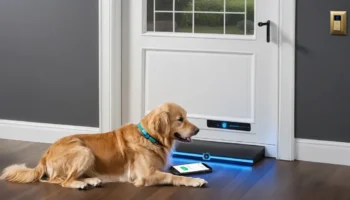
An electronic dog door uses smart technology to grant your pet selective access while blocking unauthorized animals and people. Unlike a traditional flap, it only opens for your pet’s unique identifier – an RFID collar tag, a microchip, or a Bluetooth proximity tag, depending on the model.
This gives you programmable access control that a plain flap door simply can’t match.
Modern models add weather resistance, app connectivity, and multi-pet recognition. Whether you’re at work or asleep, your pet gets safe, independent access without opening up your home to whatever wanders by outside.
Key takeaways:
- Electronic dog doors identify pets by RFID collar tag, microchip, or Bluetooth tag, and only open for verified pets – unlike flap doors, which anything can push open.
- Prices range from around $150 for a basic RFID model to $699 for a premium retrofit system like Pawport.
- Only some models offer app control and remote scheduling; if that matters to you, check the spec sheet before buying, since it varies even within a single brand’s lineup.
- Dual-door and airlock-style designs offer the best defense against raccoons and other wildlife.
- Most dogs adapt to a new electronic door within a few days to two weeks, using positive reinforcement.
How Electronic Dog Doors Work: Technology Explained
Electronic dog doors are a significant step up from basic flap systems. They use recognition technology to verify your pet’s identity before opening.
The system operates quietly, creating a smooth experience for both pets and owners.
Understanding the technology behind these doors helps you choose the right model for your household.
Recognition Systems Compared
Today’s electronic dog doors primarily use three identification methods:
- RFID Collar Tags: Small, lightweight tags attach to your pet’s collar and communicate with the door sensor. When your pet approaches, the door detects the signal and opens automatically.
- Microchip Recognition: Some models can read your pet’s existing veterinary microchip, so there’s no extra collar attachment needed. This works well for pets who tend to lose collars.
- App-Controlled Systems: Newer models connect to your smartphone for remote operation, access scheduling, and real-time entry/exit notifications. Not every electronic door has this – some brands only offer app control on a separate, pricier model in their lineup, so double-check before you buy if it matters to you.
Dual-Door Security Design
Several models use a dual-door system that meaningfully improves security. The outer door only opens once your pet’s identification is verified, creating an airlock-style barrier between interior and exterior spaces.
Built from steel and aluminum components, these doors are built to resist determined wildlife while holding up to weather.
Unlike single-flap models that raccoons or stray animals can push open, a verified electronic door won’t budge for an unrecognized visitor.
Power and Connectivity Features
Electronic dog doors handle power differently depending on the design. Collar-key models like PlexiDor and the High Tech Pet PX series plug into a standard outlet (some can be hardwired) and use battery-powered collar tags that typically need new batteries every few months to a year, depending on use.
Sliding-door openers like Wayzn run on AC power through a wall adapter rather than an internal battery, since they’re moving a much larger, heavier door panel.
App-connected models add real-time status updates and low-battery alerts for the collar tag or key straight to your phone.
Top Electronic Dog Doors: Expert Reviews
The electronic dog door market has expanded a lot in the past few years, and it now includes everything from simple RFID flaps to premium app-controlled retrofit systems. Picking the right one means knowing which features earn their price tag.
Here’s how five of the most established options compare.
High Tech Pet PX-1 Power Pet
The High Tech Pet PX-1 remains one of the best-known names in electronic dog doors, and for good reason: it’s been on the market for well over a decade and has a large base of long-term owners.
The standard PX-1 uses RFID collar tags and works with both wall and door mounting. High Tech Pet also sells a WiFi-connected version (the PX1-WIFI) that adds app control, 24/7 access scheduling, and usage history – features the base model doesn’t have.
Key advantages:
- Slim, airtight design that’s less than two inches deep
- Automatic safety retraction if the panel meets an obstruction while closing
- Available in medium and large sizes, with both wall- and door-mount kits
- WiFi model available for owners who want app-based scheduling and remote control
One thing to watch for: reviewers consistently mention that the motor noise takes some dogs a few weeks to get used to. Start training well before you need your pet to rely on the door daily.
PetSafe Electronic Pet Door
PetSafe’s collar-key pet door has been rebranded – it’s now called the Electronic Pet Door, though it’s the same product long known as the PetSafe Electronic SmartDoor. It remains the most budget-friendly entry point into electronic pet doors.
This model uses a battery-operated key worn on your pet’s collar and supports up to five programmable keys, making it a solid option for multi-pet households on a budget.
Notable features:
- Affordable entry point into electronic dog door technology
- Programmable for up to five SmartKeys, so multiple pets can share one door
- Compact design suitable for standard door cutouts
- Three access modes: key-only, fully locked, or unlocked for any pet
If you specifically want app control and remote scheduling from PetSafe, look at their separate SmartDoor Connected line instead – it’s Wi-Fi enabled, works with the My PetSafe app, and supports both a Pet Door Key and (on the medium size) direct microchip pairing for cats. It costs more than the basic Electronic Pet Door, but it’s the PetSafe model built for smartphone control.
Pawport Smart Pet Door
Pawport is the newest and most premium option here, having launched in late 2025 after appearing as a prototype at CES the two years prior. At $699, it’s the most expensive door in this roundup – but it’s also the most heavily engineered.
Rather than replacing your entire door, Pawport clips onto or over an existing pet door opening, using aircraft-grade aluminum construction and dual steel deadbolts for security. It uses a waterproof Bluetooth tag ($49 per pet) rather than RFID, and connects to Alexa, Siri, and Google Assistant.
Standout qualities:
- Dual steel deadbolts that reviewers rate as the most secure option on this list
- Retrofits onto most existing pet door openings, with a guarantee that it will fit
- Full smart-home integration, including voice control and automations
- Optional internal battery keeps the door working through a power or WiFi outage
The tradeoff is cost: at $699 for the door plus $49 per pet tag, it’s roughly two to three times the price of a mid-range electronic door. It’s worth it if security and build quality are non-negotiable for you; if budget is the main concern, one of the RFID options below will serve you just as well for daily use.
Wayzn Smart Sliding Door Opener
It’s worth clarifying what Wayzn actually is, since it’s easy to assume it’s a flap-style pet door like the others on this list. It isn’t. Wayzn is a motorized arm that attaches to your existing sliding glass door and pushes the entire door open and closed – there’s no small pet-sized opening cut into anything.
That makes it a genuinely different category of product: instead of a dedicated pet opening, your whole sliding door becomes the “pet door,” triggered by the built-in motion sensor or the Wayzn app. A pet tag for hands-free entry is now available, after a long stretch where the product only supported motion detection and app/Alexa control.
Key details:
- Opens the full sliding door rather than a dedicated pet-sized flap
- Motion sensor lets pets go out on their own; coming back in currently needs the app, a voice command, or the now-available pet tag.
- Integrates with Alexa, Google Home, and Ring cameras
- No cutting or permanent modification to the door itself – it installs with peel-and-stick adapters and screws.
This is the right choice, specifically if you have a sliding glass door and don’t want to install an insert or cut a hole in it. It’s not a good fit if you want a dedicated small opening that keeps the rest of the door sealed and closed.
PlexiDor Electronic System
PlexiDor takes a different approach from the flap-based competition: its panel slides up and down like a miniature garage door, and it uses RFID collar keys rather than an app.
This model has stayed popular for years thanks to consistent performance, no batteries to replace in the main unit, and genuinely well-regarded customer support.
Why owners choose PlexiDor:
- Rigid composite panel instead of a flexible flap, with no batteries to swap in the door itself
- Plugs into a standard outlet or can be hardwired
- Accommodates dogs up to 125 lbs, with wall- or door-mount options
- Five-year warranty on the electronic components, ten years on PlexiDor’s non-electronic doors
PlexiDor doesn’t offer app control at all – it’s RFID-only. If remote access matters to you, this isn’t the model to pick; if you want a durable mechanical door you can largely forget about, it’s a strong option.
Electronic Dog Door Security Benefits
Traditional pet doors create security gaps that many owners overlook. A simple flap gives unrestricted access to anything small enough to push through it – wildlife included.
An electronic dog door solves this through access control that keeps your home’s security intact.
Preventing Wildlife Intrusions
Raccoons in particular are notorious for figuring out standard pet doors, and once inside, they can create a genuinely dangerous situation for both your home and your pets.
Electronic systems remove this risk by requiring identity verification before opening. Dual-door designs create an airlock effect that even persistent animals can’t get past.
Homeowners in suburban and rural areas benefit the most here, since wildlife encounters near homes have been increasing as development continues to expand into wooded and semi-rural areas.
Deterring Potential Intruders
Security professionals note that unsecured pet doors are sometimes tested by burglars, checking for easy entry points.
An electronic dog door removes this vulnerability while keeping your pet’s access intact.
Unlike a flap that can be pried open from the outside, a verification-based system only responds to an authorized signal.
This is especially useful if you travel often or are away from home for long stretches during the day.
Controlled Access Scheduling
App-connected electronic dog doors let you set specific access windows, restricting movement during times when it isn’t safe or convenient.
This is useful when:
- You’re away from home for extended periods
- Neighborhood activity picks up during certain hours
- Weather conditions make outdoor access unsafe
- You’re running a structured potty-training schedule
Being able to temporarily disable access from your phone gives you real control over your pet’s movements, even when you’re not there – on models that support it. Not every door in this roundup has app control, so check the model spec if this feature matters to you.
Pet Safety & Health Advantages
Beyond security, electronic dog doors can meaningfully improve pet well-being through controlled environmental access.
These systems address situations a standard door simply can’t – from extreme weather exposure to neighborhood hazards.
Weather Protection Features
Well-sealed electronic dog doors help keep pets from venturing out during conditions that could put them at risk, including:
- Extreme heat that could lead to heatstroke
- Freezing temperatures that risk hypothermia
- Heavy rain or storms that could disorient a pet
- High winds
Models with strong weather seals – like PlexiDor’s rigid panel or the dual-door designs from High Tech Pet and Pawport – also help maintain comfortable indoor temperatures and can meaningfully reduce drafts compared to a flexible vinyl flap, which cuts your energy costs alongside keeping pets safer.
Preventing Dangerous Escapes
Pets that are anxious or overexcited can sometimes bolt through a traditional door, putting themselves at risk from traffic or getting lost.
Electronic systems require the pet to approach and be identified before the door opens, which naturally slows down an impulsive dash outside.
For dogs with a strong prey drive in particular, that brief pause can be the difference between staying in the yard and chasing wildlife into a dangerous situation.
Supporting Senior Pet Needs
Older pets often need more frequent bathroom breaks, but may struggle to push through a heavy traditional flap.
Electronic systems remove that physical effort, making independent access realistic for arthritic or weaker pets. If joint pain is part of what you’re managing, it’s worth pairing a low-effort door with your vet’s broader mobility plan for your dog.
Many owners report a real quality-of-life improvement for senior dogs who can maintain independent bathroom access without needing a person there every time.
Installation Guide: Getting It Right the First Time
Proper installation is what determines whether your electronic dog door works reliably for years or becomes a recurring headache.
Modern units include detailed instructions that make DIY installation realistic for most homeowners, though a few models (like PlexiDor’s wall units) are commonly professionally installed.
Pre-Installation Assessment
Before you buy, work through these factors:
- Wall or door type: Decide whether you need a wall-mounted or door-mounted system
- Pet size and mobility: Measure your pet’s width at the shoulders and height at the withers
- Climate considerations: Look for models with weather sealing appropriate for your region
- Power source access: Plan for a nearby outlet, or confirm whether the model you want supports battery-only operation
Manufacturers provide sizing charts for a reason – incorrect sizing is the most common installation mistake, and it leads to either security gaps or a pet who simply won’t use the door.
Step-by-Step Installation Process
- Template and Marking: Use the provided template to mark the cutout dimensions
- Cutting Opening: Cut the opening carefully with tools suited to your surface type
- Frame Installation: Secure the inner frame with the included hardware, keeping it level
- Weatherproofing: Apply sealant around the frame to block air and water infiltration
- Electronic Components: Install sensors and control units per the manufacturer’s instructions
- Testing: Confirm the door responds correctly to your pet’s tag or collar key before finishing up
For wall installations that involve cutting through structural elements, it’s worth consulting a professional. Door-mounted systems are generally simpler and need fewer tools.
Troubleshooting Common Issues
Even with careful installation, some adjustment period is normal. Here’s how to handle the most common issues:
- Pet reluctance: Use positive reinforcement with treats near the door, and let your pet approach on their own timeline
- False triggers: Adjust sensor sensitivity so wind or debris doesn’t set off the door
- Battery drain: Check whether extreme temperatures are affecting the collar tag’s battery life
- Weather stripping gaps: Replace worn seals annually to maintain insulation
Most manufacturers offer video tutorials and customer support for installation issues, and the better-reviewed brands (PlexiDor and High Tech Pet in particular) are known for responsive support even years after purchase.
Smart Electronic Dog Door Buying Guide: 7 Features to Prioritize
With this many options on the market, picking the right electronic dog door comes down to knowing which features actually matter for your household.
Recognition Technology Reliability
The core functionality depends on an identification that works consistently. Look for:
- Multiple recognition methods (RFID plus microchip, or a Bluetooth tag), if you want flexibility
- Adjustable sensitivity settings, particularly if you have pets with different coat types
- A fail-safe that defaults to closed if the sensor loses power or signal
- A track record of reliable performance in owner reviews, not just marketing claims
Be wary of any door with a pattern of complaints about frequent recalibration or inconsistent recognition in its reviews.
Weather Resistance
Your electronic dog door needs to hold up to your local climate. When comparing models, check the manufacturer’s specific:
- Stated temperature operating range for your climate
- Waterproofing rating or certification, if published
- Insulation quality of the panel or flap material
- Owner reports on performance in genuinely extreme weather, not just the marketing copy
Manufacturers don’t all publish directly comparable weather specs, so cross-check the product page and recent owner reviews rather than relying on a single number.
Power Options and Backup
Reliable operation depends on sensible power management:
- Expected collar-tag or key battery life (this varies significantly by brand and use)
- Backup power options for outages
- Low-battery warnings, ideally sent to your phone if the model is app-connected
- Whether the main unit runs on batteries, an outlet, or both
The most convenient systems pair a plug-in main unit with a long-lasting collar tag battery and phone alerts for low power.
Security Construction Quality
Check the physical build for security:
- Frame material – aluminum or steel holds up better than plastic for high-security needs
- Locking mechanism strength, especially for dual-door designs
- Weather stripping quality
- Resistance to forced entry, which is where Pawport’s dual steel deadbolts and PlexiDor’s rigid panel both stand out
App Connectivity Features
If you want a connected model, verify:
- Real-time usage notifications
- Remote access control
- Activity/usage history
- Integration with other smart home systems, if that matters to you
Not every brand offers this on every model – as covered above, both High Tech Pet and PetSafe reserve app control for a separate, higher-priced product line rather than including it across the board.
Multi-Pet Support
For multi-pet households, confirm the system handles:
- Enough pet profiles or keys for your household size
- Individual access scheduling, if the model supports it
- Reliable, distinct identification for similarly sized pets
- Straightforward profile management, especially if you’ll be adding or removing pets over time
Warranty and Support
Protect your investment by checking:
- Warranty length – PlexiDor’s five-year warranty on electronic components is one of the longer ones in this category
- Customer support quality, based on recent reviews rather than marketing copy
- Whether installation assistance is included
- Any ongoing software or app update commitments for connected models
Electronic Dog Door Comparison Table
| Feature | High Tech Pet PX-1 | PetSafe Electronic Pet Door | Pawport | Wayzn | PlexiDor Electronic |
|---|---|---|---|---|---|
| Price Range | $$ (standard) / $$$ (WiFi) | $ | $$$$ ($699 + $49/tag) | $$$ | $$$ |
| Recognition Type | RFID / Microchip | RFID collar key | Bluetooth proximity tag | Motion sensor + optional tag | RFID collar key |
| Multi-Pet Support | Unlimited | Up to 5 keys | Unlimited (per-tag pricing) | Not pet-specific | Multiple collar keys |
| App Control | WiFi model only | No (see SmartDoor Connected for app control) | Yes | Yes | No |
| Dual-Door / High Security | Yes | No | Yes (dual steel deadbolts) | N/A – opens full sliding door | Yes (rigid security panel) |
| Best For | Security-focused homes | Budget buyers | Wildlife-prone areas, max security | Homes with sliding glass doors | Long-term durability |
FAQs
How do electronic dog doors work with multiple pets?
Most systems recognize each pet’s unique tag, key, or microchip, allowing individual access settings per animal. Entry-level models like PetSafe’s Electronic Pet Door top out around five keys, while RFID systems from High Tech Pet and PlexiDor, along with Pawport’s per-pet tags, support larger multi-pet households.
Will an electronic dog door work in heavy snow or rain?
Look for models with sealed electronics and solid weatherproofing – PlexiDor’s rigid panel and the dual-door designs from High Tech Pet and Pawport are built with this in mind. Manufacturers don’t all publish directly comparable weatherproofing ratings, so it’s worth checking recent owner reviews from people in a climate similar to yours.
Can cats use electronic dog doors?
Yes, several models work for cats, especially smaller RFID or microchip units with sensitive activation thresholds. PetSafe’s medium SmartDoor Connected, for example, pairs directly with common cat microchip formats.
What happens during a power outage?
This depends heavily on the model. RFID and collar-key doors like the PX-1 and PlexiDor typically keep working on the collar tag’s own battery even if the main unit loses power, since the tag – not the outlet – triggers the door. Pawport offers an optional internal battery for outage backup. Wayzn, since it’s moving a full sliding door, needs its AC power connection to operate and doesn’t have a battery backup option.
Do electronic dog doors require professional installation?
Most door-mounted models are DIY-friendly and typically install in one to two hours with basic tools. Wall installations, especially through structural elements, often benefit from professional help – PlexiDor in particular recommends this for their wall units. Pawport is designed to retrofit onto an existing pet door opening without cutting anything new.

Conclusion
Electronic dog doors have come a long way from basic flap systems, and the market now spans a genuinely wide range – from a $150 RFID door to a $699 app-controlled security system.
By restricting access to your own verified pets, these systems address the wildlife-intrusion and security risks that come with a standard flap, while giving your pet real independence.
The right model for you depends on what you’re actually optimizing for: PlexiDor and the PX-1 for long-term mechanical reliability, Pawport if security and smart-home integration are worth the premium, PetSafe if budget is the priority, and Wayzn specifically if you have a sliding glass door and don’t want to modify it.
When you’re comparing options, prioritize weather resistance, security construction, and correct sizing over flashy extras – those three fundamentals determine whether the door actually works for your household years down the line.
Most dogs adjust to a new electronic door within three to five days of consistent, positive-reinforcement training – though as reviewers of the PX-1 note, don’t be surprised if a noise-sensitive dog needs a couple of extra weeks.
A quality electronic dog door is genuinely more than a convenience upgrade – it’s a meaningful safety investment for both your pet and your home.