


If you share your home with a cat, you’ve probably wondered about that mysterious aloofness—the way they seem to tolerate humans rather than depend on them.
Unlike dogs, who wear their hearts on their sleeves, cats maintain an air of independence that hints at a complicated past. A groundbreaking scientific study just revealed why: our feline companions began their journey into human homes far more recently than anyone imagined.
For decades, scientists believed cats began accompanying humans in the prehistoric era, roughly 6,000 to 7,000 years ago, when farming communities in the Near East supposedly brought them along while migrating to Europe.
This narrative painted cats as ancient partners in early agriculture, protecting grain stores from rodents. But new ancient cat genetics research completely upends this story—and the real cat domestication timeline is much more recent and far more fascinating.
The implications matter to every cat owner today. Understanding when and how cats entered human society helps explain their unique behavior, their special bond with us, and even their health needs.
Let’s explore what this revolutionary study discovered about your cat’s ancestors and what it means for the modern pet owner.
Study Changes Everything We Thought About Cat History
Your house cat—whether a purebred Siamese or a shelter tabby—carries DNA that tells a story stretching back thousands of years. Until now, that story was mostly guesswork.
Scientists could see that domestic cats descended from the African wildcat (Felis lybica), but the when, where, and how remained fuzzy.
This new research is significant because it replaces speculation with concrete genetic evidence. By analyzing ancient cat DNA, researchers created the most detailed cat domestication timeline ever assembled.
The results don’t just satisfy academic curiosity—they help us understand why cats behave so differently from other domesticated animals.
For pet owners, this is like finally getting your cat’s family album. It explains their independent nature, their selective affection, and perhaps why they still seem half-wild despite centuries of companionship.

What Scientists Used to Believe About Early Cats
The Old Theory: Farmers and Their Feline Partners
The traditional story went like this: as humans in the Fertile Crescent began farming around 10,000 years ago, they stored grain that attracted mice.
African wildcats slinked in to hunt the rodents, and humans welcomed these natural pest controllers. Over generations, these wildcats grew tamer, eventually becoming the domestic cats we know today.
When Near Eastern farmers migrated to Europe roughly 6,000–7,000 years ago, the theory held that cats came along for the ride. This would mean European domestic cats have been here since prehistoric times—essentially as long as agriculture itself.
This narrative made sense. It explained cats’ utility and paralleled how scientists believe dogs were domesticated (hunter-gatherer partnerships). But there was one problem: no solid evidence.
Why the Old Theory Didn’t Add Up
Scientists had discovered cat remains in prehistoric European sites, but they couldn’t definitively prove these were domestic cats rather than wild ones that wandered near human settlements. The bones looked similar. Without genetic testing, assumptions filled the gaps.
The timeline also seemed suspiciously early. Dogs were domesticated 15,000–40,000 years ago, but cats—as the last major animal to join human society—might have taken a different path. The old theory simply assumed they followed the same pattern as other livestock.
Key Discoveries About the Cat Domestication Timeline
The international research team, led by geneticist Claudio Ottoni from the University of Rome Tor Vergata, published their findings in the journal Science. Their work reveals a dramatically different story about how cats domesticated Europe.
The Shocking Truth: Cats Came to Europe Much Later Than We Thought
Here’s the headline: domestic cats didn’t arrive in Europe until approximately 2,000 years ago—during the height of the Roman Empire. This pushes the cat domestication timeline forward by at least 4,000 years from what scientists previously assumed.
The study examined cat remains from 97 archaeological sites across Europe and the Near East, analyzing bones dating from 10,000 years ago all the way to the 19th century.
By extracting and sequencing ancient DNA from 225 cat bones (both domestic and wild), the team produced 70 complete ancient cat genomes—a massive dataset that provided unprecedented clarity.
What they found was definitive: those prehistoric European cat bones belonged to wildcats, not early domestic cats. The first genetically domestic cats in Europe appear in the archaeological record around the first century AD.
Two Waves of Feline Migration from North Africa
The research identified not one, but two distinct phases of cat migration from North Africa to Europe:
First Wave (2,200 years ago): Wild cats from northwest Africa reached the island of Sardinia. However, genetic analysis confirms these were not domesticated animals. Today’s Sardinian wildcats are actually descendants of these early migrants, representing a unique population that never fully entered the human sphere.
Second Wave (2,000 years ago): Roughly two centuries after the Sardinian migration, a separate group of already-domesticated cats left North Africa for mainland Europe. These cats carried the genetic markers of modern domestic cats, making them the true ancestors of today’s European house cats.
This two-wave pattern reveals that cat domestication wasn’t a single event but a complex process happening across different regions and cultures.
How Roman Ships Became the First Cat Carriers
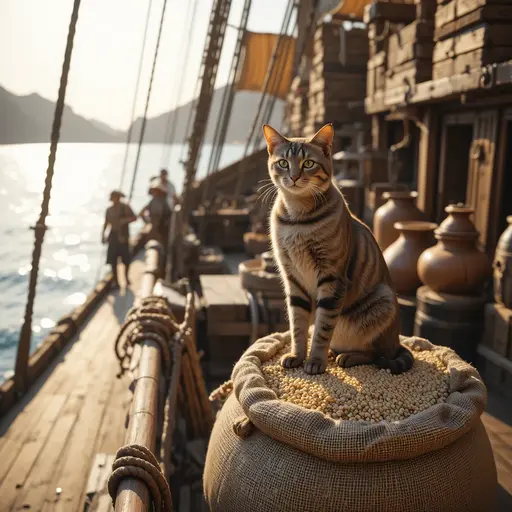
So how did these domestic cats make the journey? The evidence points to maritime trade routes across the Mediterranean Sea during the Roman Empire.
Roman ships carried grain from Egypt’s fertile fields to feed Rome’s enormous population and supply military outposts throughout Europe. Where there’s grain, there are rats—and where there are rats, cats naturally follow. Sailors likely welcomed cats aboard as essential crew members, controlling rodent populations that could destroy precious cargo.
But the relationship may have been more than practical. In ancient Egypt, cats held deep religious and symbolic significance. Pharaohs kept them as revered pets, sometimes mummifying them in elaborate coffins. These cultural attitudes likely traveled alongside the practical need for pest control.
The Roman army then served as the distribution network. Military camps and settlements across Europe—from Britain to the Danube frontier—show cat remains with domestic genetics.
The oldest confirmed domestic cat in Europe was found in Mautern, Austria, at a Roman fort along the Danube River, dating between 50 BC and 80 AD. This cat’s genome matches modern domestic cats, placing it squarely in the Roman era.
How Researchers Conducted the Study
You might wonder how scientists can extract DNA from a 2,000-year-old cat bone. The process combines archaeology with cutting-edge genetics in a way that’s fascinating yet surprisingly straightforward.
Pulling DNA from the Past
When an animal dies, its DNA begins breaking down into tiny fragments. In dry, cool conditions—like those found in many archaeological sites—some of these fragments survive for millennia. Researchers carefully drilled small samples from ancient cat bones, then used chemical processes to isolate the remaining DNA.
The challenge? Ancient DNA is scarce and contaminated with bacteria, fungi, and modern human DNA from handling. Scientists use special clean rooms and sophisticated software to separate the true cat genetic material from all the “noise.”
Building the Ancient Cat Family Tree
The team collected samples from 97 archaeological sites spanning Europe and the Near East, creating a geographic and chronological map. They focused on mitochondrial DNA (passed down from mother to offspring) and nuclear DNA (the complete genetic blueprint).
By comparing these ancient genomes with DNA from modern domestic cats and wildcats, researchers could identify relationships and track genetic changes over time. Think of it like creating a family tree that stretches back 10,000 years, with each genome representing a branch that shows when and where populations split or mixed.
The massive sample size—225 bones producing 70 usable ancient genomes—gives this study remarkable statistical power. Previous research worked with only a handful of samples; this study provides a robust, continent-wide picture.

What This Means for Modern Pets and Owners
Understanding this revised cat domestication timeline isn’t just academic trivia—it offers practical insights for today’s cat parents.
Your House Cat Shares DNA with Roman Empire Felines
When your cat lounges on the windowsill or stalks a toy mouse, they’re displaying behaviors shaped during those Roman trade routes. The genetic markers found in that 2,000-year-old Austrian cat are present in modern breeds from Persians to Maine Coons.
This relatively recent domestication explains why cats retain so many wildcat characteristics:
- Solitary hunting instincts: Unlike pack-hunting dogs, your cat’s ancestors hunted alone, which is why they prefer solo play and may seem less eager to please.
- Territorial nature: Wildcats maintain large territories, explaining why your cat rubs against furniture (marking with scent glands) and may stress during moves.
- Dietary preferences: As obligate carnivores who hunted small prey, modern cats still need high-protein diets and may turn up their noses at plant-filled foods.
Knowing this helps you create a home environment that respects their evolutionary needs: high perches for surveying territory, puzzle feeders that simulate hunting, and quiet spaces where they can retreat like the solitary predators they fundamentally remain.
Why Cats Bond Differently Than Dogs
The study’s timeline reveals why the cat-human bond differs so dramatically from the dog-human relationship. Dogs joined human society 15,000+ years ago, co-evolving with us as hunting partners and family members. They read our facial expressions, follow our pointing gestures, and look to us for guidance.
Cats, however, arrived in human society fully formed as effective predators. They didn’t need us to survive—they chose proximity because it benefited them. This difference shaped their social cognition:
- Cats recognize their owners’ voices but may choose not to respond (independence).
- They form attachment bonds but express them subtly through slow blinks, head bumps, and proximity rather than overt obedience.
- Their communication style mimics kitten-mother interactions with humans, suggesting they see us as caregivers rather than pack leaders.
Understanding this evolutionary difference can transform your relationship with your cat. Instead of expecting dog-like devotion, appreciate their unique expressions of trust and the fact that their companionship is genuinely voluntary.
Practical Takeaways for Cat Owners:
- Respect their space: Your cat’s ancestors weren’t pack animals. Provide hiding spots and don’t force interaction.
- Engage their hunter instincts: Use wand toys that mimic prey movement; rotate toys to prevent boredom.
- Maintain routine: Wildcats stake out predictable territories. Sudden changes in food, location, or schedule trigger stress.
- Watch for “wild” behaviors: Scratching, scent marking, and dawn/dusk activity peaks are normal, not behavioral problems.
What Leading Geneticists Say About Our Feline Companions
The study’s authors emphasize that these findings represent a pivotal moment in understanding our relationship with cats.
Claudio Ottoni, the lead geneticist, explains that while they’ve firmly established when domestic cats first entered Europe, the initial domestication process remains mysterious. “Cat domestication is complex,” Ottoni notes, suggesting that the journey from wildcat to house pet didn’t happen in one place or time.
Marco Di Martino, a paleontologist and co-author, highlights the broader significance: “Cats are not just another species arriving on a new continent. They are animals that have become deeply integrated into human societies, economies, and even beliefs.”
This integration happened during recorded history—meaning ancient Romans left behind written and archaeological evidence of the first European cat owners.
Pia De Kooper, a zooarchaeologist involved in the study, points out that the timing aligns perfectly with Mediterranean trade peaks. She suggests cats traveled not just as pest control but potentially as animals of “religious and symbolic value,” hinting that emotional connection—not just utility—drove their spread.
These expert perspectives remind us that cat domestication wasn’t a human project but a feline decision. Cats essentially domesticated themselves, choosing proximity to humans when it suited them while retaining their essential nature.
Limitations and What We Still Don’t Know
Every scientific study answers some questions while raising new ones. This research brilliantly illuminates the cat domestication timeline for Europe, but leaves several mysteries unsolved.
The Initial Domestication Question Remains
The most significant gap: where and when did the first domestication actually occur? The study confirms domestic cats came from North Africa to Europe 2,000 years ago, but it can’t pinpoint the original domestication event. Did it happen in Egypt? Elsewhere in North Africa? And was it one continuous process or multiple independent events?
Researchers suspect the initial taming happened in Egypt based on the intense cultural reverence for cats there, but genetic evidence for this earliest phase remains elusive.
The Sardinian Wildcat Enigma
Those wildcats that reached Sardinia 2,200 years ago never became domesticated, yet they’ve survived as a unique population. Why did they remain wild while their mainland cousins embraced human society? Understanding this difference could reveal crucial factors in the domestication process.
Genetic vs. Cultural Domestication
Genetics tells us when populations split, but they don’t reveal the full story of human-cat relationships. Did ancient Romans keep cats as pets in the modern sense, or were they simply tolerated pest controllers? The line between “commensal animal” (living near humans) and “domestic pet” is blurry, especially in archaeology.
Modern Breed Development
The study focused on broad population movements, not the later development of specific breeds. How did we get from those Roman-era cats to today’s 70+ recognized breeds? That’s a separate chapter in the domestic cat history story.
These limitations don’t weaken the study’s conclusions—they highlight how science builds knowledge incrementally. Each discovery opens new research avenues, and the team is already planning follow-up studies.

Conclusion
Your cat’s journey to your living room began not in the misty depths of prehistory, but during the rise of the Roman Empire—a mere 2,000 years ago.
This revised cat domestication timeline reveals that cats are relative newcomers to human society, which explains their independent spirit and the unique nature of our bond.
The study teaches us several important lessons:
- Cats chose us, not the other way around. They entered human society as capable predators who found our grain stores and ships convenient, not because we selectively bred them for specific tasks.
- The Roman Empire shaped modern pet ownership. Those ancient trade routes did more than move grain; they distributed the ancestors of virtually every European and American house cat.
- We’re still learning. The initial domestication event remains a mystery, reminding us that science is a process of continuous discovery.
For cat owners, this research validates what you already suspected: your feline companion is a small, perfectly adapted predator who shares your home by choice. Their behaviors—hunting, territorial marking, solitary play—aren’t quirks to be trained away but reflections of a recent wild heritage.
The next time your cat ignores your call to come inside or brings you a “gift” of a toy mouse, remember: you’re seeing behaviors that helped their ancestors survive on Roman grain ships and in ancient Mediterranean ports. That aloofness isn’t rejection; it’s 2,000 years of evolutionary wisdom.
As genetic techniques improve, we’ll likely discover even more about where and how the first wildcat decided human company was worth the trade-off.
For now, we can appreciate that our relationship with cats is younger than Christianity, younger than the Roman Colosseum, and still evolving. The cat domestication timeline isn’t finished—it continues every time a kitten purrs in a human lap.