






The best orthopedic dog bed for large breeds with arthritis uses true high-density memory foam at least 4–7 inches thick with a CertiPUR-US-certified core, bolstered edges for neck support, and a removable waterproof cover. Choose a bed sized so your dog can stretch fully without hanging off the edges.
For dogs over 70 pounds, multilayer foam construction prevents “bottoming out” on hard floors, which can worsen joint pain. Clinical studies at the University of Pennsylvania show that quality orthopedic beds improve mobility, reduce stiffness, and increase quality of life in large dogs with arthritis.
Why the Right Bed Matters for Large Breeds with Arthritis
Arthritis is not a minor inconvenience for large dogs—it is a progressive, degenerative condition that directly impacts their ability to walk, climb stairs, and rest comfortably.
According to the American College of Veterinary Surgeons, osteoarthritis (OA) causes inflammation and breakdown of cartilage, joint capsule, and underlying bone, leading to pain, reduced mobility, and muscle loss.
Large breeds such as Labrador Retrievers, German Shepherds, Golden Retrievers, and Great Danes are disproportionately affected by their size and genetic predisposition to developmental orthopedic diseases, including hip and elbow dysplasia.
When a 90-pound dog lies on a thin, polyfill bed, their weight compresses the filling within weeks. The dog ends up resting on the hard floor beneath, with pressure concentrated on its hips, elbows, and shoulders.
Over time, this pressure accelerates cartilage damage and increases inflammation. A properly constructed orthopedic dog bed for big dogs distributes weight evenly, eliminates pressure points, and allows inflamed joints to recover during rest.
Cornell University College of Veterinary Medicine emphasizes that while there is no cure for osteoarthritis, multimodal management—including weight control, low-impact exercise, and environmental modifications like supportive bedding—can significantly slow progression and maintain quality of life.
How Arthritis Affects Large Dogs Differently
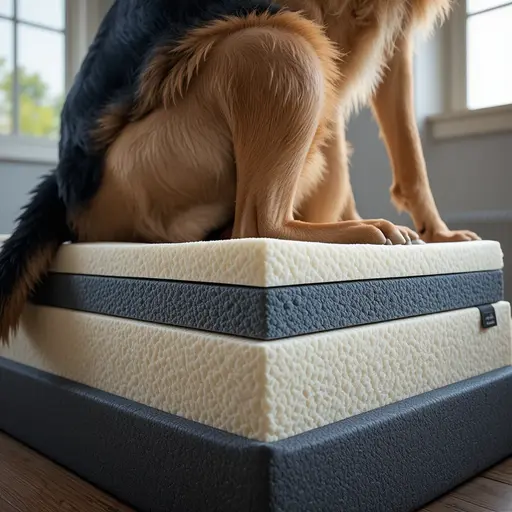
Small dogs with arthritis can often compensate by being carried or using pet stairs. Large dogs do not have that option. Their mass amplifies every joint stressor. A large breed dog bed joint support system must account for:
- Greater load per square inch: A 100-pound German Shepherd exerts significantly more pressure on hip joints than a 20-pound spaniel.
- Longer limbs and wider frames: Standard dog beds often force large breeds to curl unnaturally or dangle limbs off the edge, twisting joints.
- Faster progression: Large breeds tend to develop arthritis earlier and progress more rapidly without intervention.
The Role of Sleep Quality in Joint Health
Dogs with arthritis often wake stiff and sore. Poor sleep quality increases cortisol, reduces muscle recovery, and lowers pain tolerance.
A vet-recommended dog bed for arthritis does more than cushion—it creates a microenvironment where joints decompress, muscles relax, and the inflammatory cycle interrupts itself.
The American Veterinary Medical Association notes that rest and recovery are foundational components of osteoarthritis management alongside pharmaceutical and surgical options.
What Makes a Dog Bed Truly Orthopedic (Not Just Marketing)
The word “orthopedic” is not regulated in the pet industry. A bed labeled orthopedic may contain nothing more than cheap egg-crate foam or recycled polyester fill.
Dr. Danielle Page, a practicing veterinarian, explains that “there is no regulation around the term ‘orthopedic.’ So it gets bandied around a lot as a marketing ploy.” To find a bed that actually helps, you need to evaluate materials and construction with a critical eye.
Memory Foam vs. Orthopedic Foam: What’s the Difference?
- Memory foam conforms to your dog’s body shape, distributing weight evenly and reducing pressure on joints. True memory foam uses viscoelastic polymers that respond to heat and pressure.
- Orthopedic foam generally refers to high-density polyurethane foam designed for support. It is firmer and more resilient than standard polyfill.
The best orthopedic dog bed for large breeds with arthritis typically combines a dense orthopedic foam base layer for structural support, topped with a memory foam comfort layer that molds to the dog’s contours.
Foam Density and Thickness: The Non-Negotiables
For large breeds, thickness is everything. Beds under 3 inches will flatten under a heavy dog within months. Cornell’s veterinary guidance and multiple clinical sources recommend:
| Dog Weight | Minimum Foam Thickness | Recommended Construction |
|---|---|---|
| 50–70 lbs | 4 inches | Dual-layer (orthopedic base + memory foam top) |
| 70–100 lbs | 5–6 inches | Triple-layer with high-density base |
| 100+ lbs | 6–7+ inches | Clinical-grade multilayer foam |
A simple test: press your hand firmly into the foam. If it rebounds slowly and maintains its shape, you are likely looking at genuine supportive material. If it springs back immediately or collapses completely, it will not support a large arthritic dog.
Certifications That Actually Matter
- CertiPUR-US: Certifies that foams are made without harmful chemicals, heavy metals, or ozone depleters.
- OEKO-TEX Standard 100: Ensures textiles are free from toxic substances.
- Clinical trial backing: The University of Pennsylvania conducted a clinical trial on a specific large-breed orthopedic bed, finding that dogs using it experienced a 21.3% reduction in pain severity, a 17.6% increase in joint function, and a 12.5% reduction in joint stiffness.
Best Orthopedic Dog Bed for Large Breeds with Arthritis: Decision Framework
Choosing the right bed requires more than clicking “add to cart” on the first listing with five stars. Use this four-step framework to evaluate any orthopedic dog bed for big dogs before purchasing.
Step 1: Match Bed Size to Your Dog’s Sleeping Style
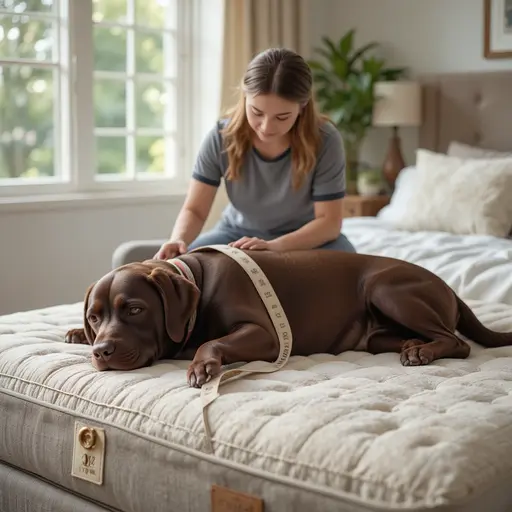
Measure your dog from nose to tail while they are fully stretched out. Add 6–12 inches to determine the minimum bed length. If your dog curls up, a nest-style bed with bolsters may work. If they sprawl, a flat mattress-style bed with no raised edges provides more usable surface area.
For large breeds, err on the side of too large rather than too small. A cramped bed forces joints into unnatural angles and concentrates pressure on limbs hanging off the edge.
Step 2: Evaluate Foam Construction and Layering
Look for beds that disclose their foam layers openly. Avoid vague descriptions like “premium orthopedic foam” without specifics. Ideal construction for large breeds includes:
- Base layer: High-density orthopedic foam (firm, supportive, prevents bottoming out)
- Support layer: Transition foam or additional high-density layer
- Comfort layer: Memory foam that contours to the body
- Optional cooling layer: Gel-infused foam for dogs that overheat on solid memory foam
Step 3: Check Accessibility for Stiff Joints
Arthritic dogs struggle to climb. A bed with steep bolsters or high sides becomes a barrier. Look for:
- Low front entry: One side should be easy to step over
- Non-slip base: Prevents the bed from sliding when the dog pushes off with weak hind legs
- Firm edges: Soft, collapsible bolsters make it harder for unstable dogs to lever themselves up
Step 4: Prioritize Washability and Waterproofing
Senior and arthritic dogs may have accidents, drool more, or develop incontinence. A waterproof liner protects the foam core, which cannot be washed. Removable, machine-washable covers are essential for hygiene and odor control. Charcoal-infused or antimicrobial covers add value for dogs that spend extended hours in one spot.
Scenario Breakdown: Which Bed Fits Your Dog’s Needs?
Not every large breed with arthritis has the same challenges. Match the bed to your dog’s specific situation.
Scenario A: Senior Dog with Advanced Arthritis
Profile: 10+ years old, difficulty rising, visible stiffness, possibly on NSAIDs or Librela (bedinvetmab).
Best choice: A thick, flat mattress-style bed (6–7 inches) with a low entry point, a non-slip base, and a heated option. Heated orthopedic beds increase blood flow to stiff joints and reduce morning stiffness. Avoid high bolsters that act as barriers.
Scenario B: Middle-Aged Large Breed with Early Joint Stiffness
Profile: 5–8 years old, occasional limp after exercise, no medication yet, still active.
Best choice: A dual-layer orthopedic bed with moderate bolsters (3–4 sides). This provides joint support while satisfying the dog’s instinct to rest their head. Investing early can delay progression and protect joints during peak activity years.
Scenario C: Overweight Large Dog with Hip Dysplasia
Profile: Excess weight amplifies joint stress, increases the risk of pressure sores, and may affect temperature regulation.
Best choice: A cooling gel orthopedic bed with extra-thick base foam (7+ inches). Cooling layers prevent overheating, which is common in overweight dogs on dense foam. The extra thickness prevents the dog from compressing through to the floor.
Scenario D: Post-Surgical Recovery
Profile: Recovering from TPLO, hip replacement, or other orthopedic surgery.
Best choice: A medical-grade orthopedic bed with waterproof everything, easy-access design, and washable covers. The bed should be placed in a low-traffic area where the dog can rest without being jostled.

Risk vs. Benefit Analysis: Is an Orthopedic Bed Worth the Investment?
The Cost of the Wrong Bed
A cheap polyfill bed costs $30–$60 but flattens within weeks. For a large breed with arthritis, this is not just a waste of money—it is actively harmful. Sleeping on compressed fill or hard flooring increases joint inflammation, reduces sleep quality, and accelerates muscle atrophy. Over a year, you may replace three cheap beds, spending more on one quality orthopedic option while your dog suffers.
Long-Term Health Benefits
A quality orthopedic dog bed for big dogs offers benefits beyond immediate comfort:
- Pressure sore prevention: Thin beds create pressure points on bony prominences, especially in lean or elderly dogs.
- Improved mobility: Better rest leads to less morning stiffness and more willingness to move, which maintains muscle mass.
- Reduced medication dependence: While beds are not a replacement for veterinary treatment, improved comfort can reduce the frequency of breakthrough pain episodes.
When to Save and When to Splurge
Worth the investment:
- Beds with true memory foam, multilayer construction, and clinical backing
- Waterproof liners and durable, replaceable covers
- Beds sized specifically for large and giant breeds (not “one size fits all”)
Not worth the premium:
- Beds marketed as orthopedic but using egg-crate foam or thin convoluted layers
- Designs with excessive decorative features that compromise function
- Beds without washable covers or waterproof protection
Vet-Recommended Dog Bed for Arthritis: Features That Matter Most
Veterinarians who treat osteoarthritis consistently recommend specific features. Here is what the evidence supports.
Bolstered Edges for Head and Neck Support
Bolsters are not just aesthetic. Dogs with arthritis often have secondary neck and spine tension from compensating for sore limbs. A firm, supportive bolster allows the dog to rest their head at a natural angle, reducing cervical strain. However, bolsters should be firm and accessible—not soft, collapsing pillows that trap the dog.
Non-Slip Base for Unstable Joints
A bed that slides when a dog pushes off to stand turns a simple movement into a dangerous struggle. Rubberized, grippy bases are essential for large breeds with weak hind legs or hip dysplasia.
Temperature Regulation
Memory foam retains heat, which can be uncomfortable for thick-coated breeds or overweight dogs. Cooling gel layers, breathable covers, or elevated designs help. Conversely, thin-coated or elderly dogs in cold climates benefit from heated orthopedic beds that improve circulation to stiff joints.
Waterproof and Odor-Resistant Liners
Accidents happen. Incontinence, drooling, or post-surgical drainage can ruin an unprotected foam core. A waterproof liner between the cover and foam is non-negotiable for long-term use. Charcoal-infused or antimicrobial covers reduce odor buildup in beds used 12–16 hours daily by senior dogs.
Large Breed Dog Bed Joint Support: Sizing Guide
Getting the size wrong undermines every other feature. Use this guide:
| Breed Size | Dog Weight | Bed Dimensions (Minimum) | Foam Thickness |
|---|---|---|---|
| Large | 50–70 lbs | 36″ × 24″ | 4–5 inches |
| Extra Large | 70–100 lbs | 42″ × 30″ | 5–6 inches |
| Giant | 100–150+ lbs | 48″ × 30″ or larger | 6–7+ inches |
Measuring Your Dog Correctly
- Have your dog lie on their side in a natural sleeping position.
- Measure from the tip of the nose to the base of the tail.
- Add 6–12 inches to determine the ideal bed length.
- Measure shoulder width at the widest point and add 4–6 inches for width.
If your dog falls between sizes, always choose the larger option. A large breed dog bed joint support system only works if the entire body fits on the sleeping surface.
Common Mistakes to Avoid When Buying
- Trusting the “orthopedic” label blindly: Verify foam type, density, and thickness.
- Buying for puppy size, not adult size: Large breeds grow fast. Buy for their projected adult weight if they are under 18 months.
- Ignoring the cover quality: A great foam core with a cheap, non-removable cover becomes a hygiene problem within months.
- Choosing style over function: A bed that matches your décor but uses thin foam helps no one.
- Forgetting accessibility: High sides and deep bolsters look cozy but can trap a stiff-legged dog.
FAQ: Real Questions from Large Breed Owners
How thick should the foam be for a 100-pound dog?
At minimum, 6 inches of combined high-density and memory foam. A 100-pound dog will compress 3-inch foam to the floor within days. For giant breeds over 120 pounds, 7 inches is the clinical standard.
Can an orthopedic bed cure my dog’s arthritis?
No. An orthopedic bed cannot cure arthritis, which involves irreversible cartilage damage. However, it is a critical component of multimodal management. Cornell University College of Veterinary Medicine lists environmental modifications—including supportive bedding—as a core strategy alongside weight management, medication, and rehabilitation.
How often should I replace an orthopedic dog bed?
High-quality beds last 3–5 years with proper care. Replace the bed when:
- The foam no longer rebounds to its original shape
- Your dog avoids the bed or prefers the floor
- The cover is torn, and the foam is exposed to moisture
- Your dog’s weight or mobility has changed significantly
Are heated beds better for arthritic dogs?
Heated beds can help dogs with severe stiffness, especially in cold climates or during winter months. Heat increases blood flow and reduces joint stiffness. However, they are not suitable for all dogs—overweight dogs or those with thick coats may overheat. Always use heated beds with thermostatic controls and never leave them on unattended for extended periods.
Is memory foam safe if my dog chews?
No foam bed is safe for aggressive chewers. If your dog shreds bedding, look for durable, chew-resistant covers and consider consulting a veterinary behaviorist. Ingested foam can cause intestinal obstruction.
Final Recommendation: Choosing the Best Orthopedic Dog Bed for Large Breeds with Arthritis
The best orthopedic dog bed for large breeds with arthritis is one that uses clinically tested, multilayer high-density foam at least 4–7 inches thick, includes a waterproof liner and washable cover, and is sized generously for your dog’s full stretched length. It should have a non-slip base, accessible entry, and bolsters firm enough to support the head without trapping the body.
Use the decision framework above to evaluate any bed against your dog’s weight, sleeping style, mobility level, and environment. Do not be swayed by marketing language or decorative features. For large dogs with arthritis, sleep surface quality directly impacts daily pain levels, mobility, and long-term joint health.
If your dog is already showing signs of stiffness, limping, or difficulty rising, schedule a veterinary examination to stage their osteoarthritis and build a comprehensive treatment plan.
The right bed is a powerful tool—but it works best as part of a complete care strategy that includes weight management, appropriate exercise, and veterinary-guided pain control.